
Altona Meadows Streets - History
Named after the three mast schooner, the Alma Doepel, which was launched in October 1903 on the Bellinger River, NSW by Frederick Doepel. The schooner was operated by him on the New Zealand trade route from Sydney until 1915. In 1916 she was sold to Henry Jones and Co. and traded between Melbourne and Tasmania. The Alma Doepel would carry preserves and timber to the mainland, usually to the port of Melbourne. On the return to Tasmania, she would transport jam jars and glass bottles (for tomato sauce), explosives (for the mines), bags of Victorian wheat and assorted household goods. The explosives that she carried came from the Truganina Explosives Reserve in Altona.
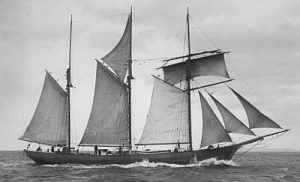 In 1927 Alma Doepel was reported as having made the fastest crossing, by any sailing vessel, between Melbourne and Hobart, taking less than two and a half days.
The Alma Doepel continued in this serve until 1943 when she was commissioned by the Army to carry provisions to troops stationed in Darwin and New Guinea. She continued in this service until 1947 when she returned to her previous service of carrying goods across Bass Strait. In 1947 her masts, which had been removed by the Army, were restored but not her square yards.
Her return to Bass Strait took her to the Tasmanian east coast port of St Helens. The entrance at St Helens was barely deep enough for her entry but often proved difficult when Alma was fully loaded with the local timber (Eucalyptus regnans or Mountain Ash). Post-war housing had created a huge demand by mainland builders who could not get enough of it. Also, the timber was turned into fine furniture for the post-war prosperous homemakers.
As well as timber, the Alma Doepel continued to carry preserves to Victoria and bottles and explosives back to Tasmania. Due to unpredictable weather conditions, a passage of Bass Strait was rarely made in one run. Usually, the Alma Doepel sheltered on the way at various anchorages in Victoria, on Flinders Island, Cape Barron Island, Banks Strait, or at any of the indentations along the east coast of Tasmania. A whole passage could take two weeks (and three weeks on one occasion). Alma Doepel would generally undertake about seven round trips between Tasmania and Victoria every year. Alma’s last interstate trading run ended on 21 February 1959.
Research: Graeme Reilly (Altona Laverton Historical Society)
Argonaut Place is named after the ketch Argonaut II that was associated with the Truganina Explosive Reserve transporting explosives to various ports around Australia.
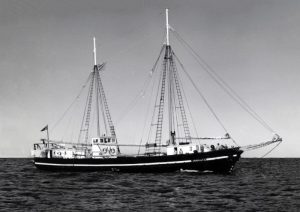 Argonaut was a 174-ton general cargo ketch built in 1947 by Arga Shipping at St Helens, Tasmania and launched on 5 May of that year.
On one of its early voyages, the Argonaut II sailed from Stanley Tasmania to Port Adelaide, a total of 500 miles, in a record time of 59 hours for the total voyage (The Age, 9 April 1948). In its early years, the ketch was used to ship cargo between the northern Tasmanian ports, Melbourne and Port Adelaide, South Australia. The ketch was known to use all her sails when the winds were favourable crossing Bass Strait.
The ketch was not without its mishaps. The Age (15 September 1952) reported that during a voyage from Sydney, whilst negotiating heavy seas, the rudder broke loss and was swept away. The quick thinking crew hastily ripped up the fore and aft hatch beams and covers and made a jury rudder. The temporary rudder was manipulated by pulleys. After sending a signal for assistance, the freighter Jillian Crouch came to her aid and towed the Argonaut II to Melbourne. However just as they were coming through the heads the tow line broke but before and damage could occur the tow line was repaired and both ships continued to Port Melbourne.
After finishing its service with the Explosive Reserve, the Argonaut II was sold and sailed to Magnetic Island in Queensland. Her new owners renovated the ketch into a floating restaurant and her new life began. In 1978 she was destroyed by fire while at anchor in Horseshoe Bay. She sunk in 6 metres of water about 300 metres from an inlet at the eastern end of the beach. The wreck is marked by a warning buoy but now has only an old oil bottle tied to the marker chain.
The following story was provided by Anthea Moon who was fortunate to have lived and worked onboard the Argonaut II after the ship finished its service with the explosive reserve. The story was edited by one of our volunteers, Adam Virgona. Link https://alhs.com.au/wp-content/uploads/2023/06/Argonaut_Anthea-Moon.pdf
In 1987, the Werribee Council undertook a redevelopment of a large section of Altona Meadows that was located south of Central Avenue and east of the Bruce Comben Reserve, extending through to Merton Street. Several streets in this area were renamed in recognition of early residents of the district and the contributions they made to the area. Fellow community members nominated these. Ashby Court is named to recognise the Ashby family members who moved into the Werribee area during the late 1800s, started their business, and contributed to the progress of the community.
The Ashby family, in Werribee, was headed by Joseph James Ashby who was born in Lonsdale Street, Melbourne, in 1848 to parents William and Catherine Ashby (nee White). After moving out of the family home and marrying, in early 1875, he and his wife, Elizabeth nee Schwerdtfeger, moved to Mornington for about a year. He was 25 years of age when he settled in Werribee and resided on the same site in Mambourin Street until his death. Joseph Ashby was a noted horseman and a keen sportsman, participating in events conducted within Werribee. He was also an avid fan and honorary member of the North Melbourne football club.
In his early years, after leaving school, he gained an apprenticeship within the saddlery trade working for a North Melbourne business known as Harry and Blake. He brought his skills to Werribee where he commenced the business of J Ashby and Sons Saddle and Harness Makers in Station Street. Joseph Ashby passed on skills, in saddlery and harness making to three of his sons, William, Joseph jnr and Frederick. Joseph and Elizabeth had ten children, Francis, Frederick, William, Ellen, Albert, Joseph, Thomas, Henry, Annie, and Elsie, none of whom were born in Werribee. On his death, in 1928, Joseph snr left the saddlery business and equipment to his son William and to Joseph jnr, an acre of land, near their home, to conduct the auxiliary service that the family rendered by the family.
Joseph jnr joined forces with Frederick and operated their saddlery business in the neighbouring township of Bacchus Marsh. Joseph returned to Werribee in the early 1930s where he rejoined William in operating the family business in Station Street Werribee. Unfortunately, after having been struck down with a serious illness, Joesph passed away in November 1933. He had been known in the district as Paddy to differentiate him from his father and had been an active member of the both the local football and cricket clubs.
The Ashby support to the local community did not stop with Joseph senior and junior, Elizabeth was also a great supporter of community life until her passing in early 1943, when the mantle was passed to William who had continued to operate the family saddlery business in Station Street. William was also a driving force behind the Werribee Mechanics’ Institute and the Werribee Football Club.
The connection of the Ashby name, with Werribee, stretched from around 1876 through the twentieth and into the twenty-first century. It is a name well-regarded in the district and worthy if its place within this estate in Altona Meadows.
By: Graeme Reilly (ALHS 2026)
 Barbara and Geoffrey Brown moved to Altona in about 1963, raising their young family in Chifley Avenue. They were both continually active in the Seves Street Methodist Church then the Presbyterian (Uniting) Church in Civic Parade. Barbara was involved with the Citizens Advice Bureau from 1980 to 1992, was a community representative on the petrochemical committee set up by council in the 1980s and volunteered at Altona Little Athletics. Barbara also regularly attended council meetings as a member of the public with a general interest in the wellbeing of her local area.
When Altona council began development of the open flat plains of grassland that were Altona Meadows, they needed names for the streets that were being created as part of this new housing estate. That is when Brown Avenue came into being, recognising Barbara’s role as an active community member contributing to the welfare of others.
Sadly, Barbara only recently passed away in February 2025, and it was in the eulogy given at her funeral by son Greg Brown that this piece of interesting family history became known.
If you look on a map at the location of Brown Avenue, you may recognise that some of the surrounding streets are also named after other early residents of Altona.
Written by: Ann Cassar (ALHS 2025)
Edited: Graeme Reilly
 Calcutta Street was named after the British Naval ship HMS Calcutta that visited Port Phillip in October 1803 with the objective of establishing a new settlement. The HMS Calcutta as the ‘Warley’ launched in October 1788 and then sold to the Royal Navy in 1795 and converted to 56 gun vessel and renamed the HMS Calcutta.
Sometime between 1802 and February 1803, the Royal Navy had the Calcutta fitted out as a transport ship for convicts being sent from Britain to her penal colonies in Australia. The Calcutta sailed from Spithead on 28 April 1803, accompanied by the Ocean, to establish a settlement at Port Phillip. Calcutta carried a crew of 150 and 307 male convicts, along with civil officers, marines, and some 30 wives and children of the convicts. The voyage took the Calcutta via Teneriffe (13 May), Rio de Janeiro (19 July) and the Cape of Good Hope (16 August).
While the Calcutta was moored at the Cape of Good Hope, a vessel arrived with news that Britain was now at war with the Batavian Republic. The colony’s Dutch commodore sent a representative aboard the Calcutta to demand her surrender. While the representative waited, the Captain of the Calcutta (Daniel Woodriff) spent two hours preparing her for battle. He then showed the representative her sailors and marines at their guns, and advised him to inform the colony commodore that “if he wants this ship he must come and take her if he can”. The response from the Dutch commodore was that he gave Woodriff 24 hours to leave, saying that he “did not wish to capture such a large number of thieves” referring to the number of convicts on board.
On 12 October, the Calcutta finally reached her destination at Port Phillip. David Collins, the commander of the expedition, found that the soil was poor and that there was shortage of fresh water which, in his opinion, made the area unsuitable for a colony. Collins decided to move the colony to the Derwent River (Hobart Town)on the south coast of Van Diemans Land (Tasmania). Captain Woodriff refused the use of Calcutta for this additional voyage, arguing that Ocean was large enough to transport the colony, and that he was under orders to pick up naval supplies for transport to England.
In December Captain Woodriff sailed on to Sydney where he took on a cargo of lumber. At midnight on 4 March 1804, Woodriff landed 150 of his crew and marines to assist the New South Wales Corps and the local militia, in suppressing a convict uprising in support of the Castle Hill convict rebellion, a revolt by some 260 Irish convicts against Governor King. The Calcutta left on 17 March 1804, doubled Cape Horn and reached Rio de Janeiro on 22 May. In reaching Rio, the Calcutta had thus circumnavigated the world in ten months three days. She arrived back at Spithead on 23 July. In September 1804 the Admiralty again fitted out the Calcutta for duty as a cruiser.
Research: Graeme Reilly (Altona Laverton Historical Society)
Image: HMS Calcutta and the Ocean at anchor in Port Phillip, from a painting by Dacre Smythe
In 1987, the Werribee Council undertook the redevelopment of a section of Altona Meadows located south of Central Avenue and east of the Bruce Comben Reserve, extending through to Merton Street. The streets in this area renamed in recognition of the contributions made by former and current residents of Laverton to their community. Seven of these residents chosen for their role as Councillors of the East or Altona Riding of the Werribee Council, whilst others were named in recognition of the contributions made by former residents to their community. One street, Canny Court, was named to honour the contribution of Councillor Denis Joseph Canny, not of Laverton but an early resident, business entrepreneur, and community spirited member of the Shire of Werribee. His obituary notes[1], in its opening paragraph, ‘no Werribee resident was better known and more highly esteemed not only in this district but throughout the State than Mr. Denis Joseph Canny.’
Denis Joseph Canny was born in Werribee in 1874 to parents Michael Canny and Margaret Canny (nee O’Keefe). Denis was the youngest of fifteen children born to the couple. Michael and Margaret migrated to Australia, from Ireland, in 1852 and then moved to the Werribee district around 1858/59, where he started farming. By then the family had seven children, with their eighth child, Thomas Michael, being born soon after they settled in Werribee.
Denis Canny undertook his primary education locally and upon leaving started farming alongside his family. At the age of twenty-seven, Denis married Catherine Margaret Shine, the eldest daughter of Daniel Shine and Mary Elizabeth Shine (nee Lacy) at St Ambrose Catholic church in Brunswick. Catherine had recently moved into the Werribee area, where the two met and fell in love. Their wedding ceremony was conducted by Fr Heaney who was later to become the first parish priest of St Andrew’s church in Werribee. Denis and Catherine settled down in Werribee where they were to integrate themselves into the district’s organisations, social and political affairs for the whole of their lives.
Denis Canny was elected to the Werribee Shire Council in 1910, and he retained his seat, within the Central Riding, until ill-health compelled his retirement in March 1935. During his twenty-five years, on council, he held the position of Shire President on three occasions. The first in 1914, when the Great War broke out, then again in 1918 when the Armistice was signed, and the last in 1934.
Denis Canny was appointed secretary of the Werribee Racing Club when it was reorganised around 1915, occupying the position continuously until his resignation in 1935, due to ill health. He was a keen and able official, taking a leading part in placing the club in a prominent position within the Victorian horse racing industry. Denis Canny was connected with most of the principal Racing Clubs in Victoria. He was a committee member of the Victoria Racing Club for a considerable time, relinquishing the position only because of his health concerns. Denis also raced several horses at various times with a fair amount of success. He was a capable judge of horseflesh and officiated in that capacity at shows. He also imported horses from New Zealand. Coursing was another sport that claimed the attention of Denis Canny. He was president of the Werribee Coursing Club for many years.
Around 1910, Denis Canny moved of the farm and into the hotelier business. Denis took over the Club Hotel, or Wall’s Hotel as it was also termed, and which became known as Canny’s Hotel. He was associated with the Racecourse Hotel, in Watton Street, between 1912 and 1914. In 1922 he became licensee of the London Tavern, in Elizabeth Street, Melbourne. Four years later, he transferred his interests to Phair’s Hotel, Collins Street. Then followed a lease of The Old London Inn, corner of Market Street and Flinders Lane. Although his principal business connections were in the city, Denis Canny continued to reside at Werribee.
In November 1926, Catherine Canny passed away suddenly at the family residence. Although she had not been in the best of health for several years, at the time of her passing she had been in good health and spirits. Catherine had provided invaluable support and assistance to St Andrew’s church and was a life governor of St Vincent’s Hospital. Denis and Catherine had had five children, four daughters and a son, but at the time of her passing two of her children had predeceased her leaving three daughters, Marie, Lucy, and Patricia.
The Picture Palais, in Station Street, was opened on 4 April 1928. It had been constructed for Melbourne promoters, W Mitchell of Elsternwick, and F Foulsham of Caulfield, with Denis Joseph Canny. The Palais replaced the old Werribee Mechanics Institute as the local cinema in Werribee.
He revealed splendid traits of citizenship and took a practical interest in every local movement, whether of a charitable, sporting, or general nature. Denis passed away on 15 August 1935, aged sixty-one years, at his home in Werribee. At that time, it was said that no other Werribee resident was better known or more highly respected than Denis Joseph Canny. Possessing a welcoming disposition, he acquired countless acquaintances who respected his character qualities in the sporting sphere and in life. Denis Canny was laid to rest within the Werribee cemetery, alongside his wife, Catherine Canny.
[1] Werribee Shire Banner, 22 August 1935, page 2.
Research: Graeme Reilly (ALHS 2025)
In 1987, the Werribee Council undertook the redevelopment of a section of Altona Meadows located south of Central Avenue and east of the Bruce Comben Reserve, extending through to Merton Street. Some of the streets in this area were renamed in recognition of the contributions made by former and current residents of Laverton to their community. Seven residents were chosen for their role as being Councillors of East and Altona Riding of the Werribee Council. One of these was Walter Edward Brass Carruthers, but this time we wish to add another name which is Lorna Annie Carruthers, Walter’s wife as her contribution to both Altona and Werribee councils is also worthy of recognition.
Walter Edward Brass Carruthers was born in Glasgow, Scotland on 20 April 1920 to parents Douglas Paton Carruthers and Isabella Carruthers (nee McInnes). He was the youngest of five children born to the couple. Less than six years later Walter, with his parents and the two youngest of his siblings, packed up their belongings and travelled to London where they boarded the ship RMS Ormonde, on 6 February 1926 board for Melbourne, Australia. The ship arrived at the port of Fremantle on 9 March before sailing on to Adeliade and then Melbourne, where the Carruthers family disembarked. The family eventually settled in the west of Melbourne, within the suburb of Sunshine where they quickly embedded themselves into their new community.
Within the Sunshine Presbyterian church congregation, that the Carruthers’ were strong supporters, was also the Andrawartha family of James Hurbert and Annie Jane who had three children of their own and the family connected. Two of their children were Frederick Gordon Andrawartha and Lorna Annie Andrawartha, who were of similar ages to both Janet Kerr Carruthers and Walter Edward Carruthers and may have known of each other attending the same school as well as from church. While the connection between the two families commenced before 1938 the marriage of Janet Carruthers to Frederick Andrawartha took place on 17 December at the Sunshine Presbyterian church, the church that both families worshipped. Walter walked his sister down the aisle in place of his father, Douglas, who had passed away six years earlier. Frederick’s younger sister, Lorna, was Janet’s bridesmaid. Whether this is where the romance between Walter and Lorna began, we do not know, but they were to marry in the same church on 17 April 1943.
When the second world war broke out, Frederick had already been in the Royal Australian Air Force for three years, his brother-in-law, Walter, initially enlisted into the Army on 8 August 1940 but discharged from there to join the Royal Australian Navy on 20 May 1943. Walter served with the navy until 6 June 1946 serving on HMAS Quadrant. It was during his change over from the army to navy that Walter wed Lorna Andrawartha. Following the end of the war, Walter, and Lorna, and their two sons, moved to Altona where the purchased vacant land in Upton Street on which they built a small bungalow, before setting about building their own home. Lorna described Altona as having no roads, to speak of, and miles upon miles of open paddocks, at that time there were only five houses in the northern section of Upton Street. It was from here that Walter and Lorna Carruthers began contributing their knowledge and skills to their new community’s growth and prosperity.
Walter Carruthers had been in scouting, starting 1st Altona Scout Troop in a private home and later with the aid of parents’ committee obtained the present scout hall site as a gift. He helped build the scout hall with locally raised funds. Walter then became a councillor with the former Altona Riding of Werribee Council from 1951 until 1954. Lorna Carruthers also helped with the scout committee and the first kindergarten committee which raised £1000, which enabled Altona to have its first kindergarten and infant welfare centre with a government subsidy.
When a vacancy arose, Lorna Carruthers accepted the appointment of Justice of the Peace. In addition to her usual work, she was the parttime receptionist to the city engineer from 1967 for more than seven years and managed to take on the role as the district guide commissioner from 1964 until 1968, which was a voluntary activity. In 1973 Lorna then applied for and accepted the role as welfare officer for Altona, the first home-help supervisor and welfare worker in the district. A few years later Walter and Lorna moved to Heaths Road Werribee, where Lorna assumed a role with the Werribee council.
Eventually, Walter and Lorna retired to the rural local of Sale where, on 19 December 1998 Walter Edward Brass Carruthers passed away and is buried within the Sale cemetery, he was seventy-eight years old. Lorna lived on in the township of Sale until her passing on 9 January 2009. She is buried within the Sale cemetery alongside her husband, Walter. Lorna was eighty-four years of age.
In 1987, the Werribee Council undertook the redevelopment of a section of Altona Meadows located south of Central Avenue and east of the Bruce Comben Reserve, extending through to Merton Street. Several streets in this area were renamed in recognition of the contributions made by former and current residents of Laverton to their community, as nominated by their fellow community members. One of these families were the Cations.
Robert Cations and his wife, Margaret Evelyn Cations (nee Watts) brought their family to the Werribee area around 1900 where he was to be employed by George Thomas Chirnside at Werribee Mansion/Werribee Park as their blacksmith and engineer. It was to be a job that he undertook and enjoyed until he passed away in 1937. When they family moved to Werribee Park, apart from Robert and Margaret, they brought their four children Frederick James, Alice Evelyn, Richard and Christine Mary. Over the next eleven years, the couple had a further five children, William Ernest, Robert Francis, Jeanette (Ettie) Spittall, Margaret Evelyn and Ida Marjorie. All but Margaret Evelyn lived into adulthood and married. Margaret passed away in 1911 at the age of three.
Werribee Park remained within the Chirnside family until 1922. During this period the Cations family not only worked for the Chirnside family but also resided on the property. Other than Robert, other members of the Cations family were employed as assistant cook and farm hands. Christine (May) Cations worked as a cook at the stately Mansion, which had been built by one of Werribee’s founding fathers, Thomas Chirnside. Her brother Robert, worked in the gardens and her youngest brother, William, supplied the table with meat and poultry. Christine was quoted as saying that “It was a beautiful way to live, there were no quarrels because everybody knew their job and did it”.
Robert Cations remained at the residence even after the Chirnside’s sold to become the Corpus Christi College training Centre for fifty years. Here young men were trained to seek to enter the priesthood in the Dioceses of Melbourne, Ballarat, Sandhurst, Sale and Hobart. Although Robert was handicapped by residing some distance from Werribee and therefore restricted from taking active interest in public matters, he gave much attention to social activities and sport, and since its inception was prominently associated with the I.N.F. Football Club[1], being a vice-president of that body and a member of the Werribee Rifle Club, where several of his sons also competed. In his younger days he was captain of the Merideth cricket team.
In 1913, at the age of twenty, the Cations’ eldest son, Frederick, joined the Royal Australian Navy where he enlisted for a period of seven years. When the war commenced, Frederick was a stoker onboard HMAS Melbourne, on which he served for the next two years. The Melbourne served as an escort ship for troop ships heading to the Middle East, before being diverted to undertake patrols in the Atlantic near Bermuda and then the east coast of North America. He returned to Australia in February 1916 where he took leave to marry Henrietta Hibbert, before he joined HMAS Brisbane that had only recently been commissioned. When the Brisbane sailed for the Mediterranean Sea Frederick was advised that he would remain in Austtralia. Frederick remained in the navy until his seven-year committed ended on 9 May 1920 and he returned to civilian life and his wife, Henrietta.
Frederick wasn’t the only one from the Cations’ clan to enlist. His brother, Richard, enlisted into the army, at Werribee, on 14 July 1915 aged eighteen. Richard was assigned to the 23rd Battalion and embarked for Egypt, on 27 October 1915, aboard HMAT Ulyssess from Melbourne. After arriving in Alexandria, Richard and the 23rd Battalion shipped out to France where they disembarked on 26 March 1916. They headed to Armentieres and the Pozieres and were involved in heavy fighting. Richard sustained a gunshot wound to his neck and forearm and was treated at the nearby Casualty Clearing House before heading to England for more treatment and rehabilitation. On 17 November 1916 he was discharged from hospital and following leave and training, he returned to his battalion, in France, on 16 April 1917 at Beugnatre.
After only two weeks back at the front, he was wounded again on 3 May 1917. The Battalion was involved in a major attack on the Hindenburg Line. Richard received a gunshot to his right knee and was treated by the 3rd Australian Casualty Clearing Station. He received further treatment at a hospital at Rouen and was able to return to is battalion on 14 May 1917 who were now at Mametz. By the end of July 1918, the 23rd Battalion were camped at Villers Bretonneux. During the fighting on 3 August 1918, Richard was wounded for a third time. This time he received a gunshot wound to his right thigh and was treated by the 6th Australian Ambulance Casualty Clearing Station before being taken to the 8th General Hospital at Rouen. From there he was invalided to England and admitted to the No.1 Southern General Hospital at Birmingham. He finally returned to Australia on 20 March 1919 and arrived home in May. After settling down, Richard Cations married Iris Fitzgibbons in 1921 at the Methodist Church, Queanbeyan, N.S.W., and they lived at Duncan’s Road, Werribee.
With the Great War over, life in Werribee and for the Cations family began to return to some level of normality. Two more of Roberts children married, William in 1925 and Alice in 1927, and the family continued living and working at Werribee Park with William joining his father as a blacksmith. By 1935, the three remaining children had married, Jeanette and Ida both in 1933 and Robert Francis in 1935, and by now Robert senior was sixty-eight years old and still practising his trade at Werribee Park. But on 13 March 1937, Robert, in his seventieth year passed away after an illness of twelve months. The past year had provided the opportunity for Robert’s numerous friends and acquaintances to visit and spend time reminiscing the old times at Werribee Park and times prior. Robert was buried in the Methodist section of the Werribee cemetery. Margaret Cations moved into the Werribee township, living with her son, Ida Marjorie Torney, and her family.
When World War 2 commenced, members of the Cations family enlisted to serve. Richard, who had served in the Great War, enlisted into the Army, joining the Volunteer Defence Corps where he served, in Australia, for just on twelve months. He was forty-five years of age. His younger brother William, aged forty, also enlisted into the Volunteer Defence Corps and served for just over three years. Richard’s son, John Richard Cations, joined the Royal Australian Navy, in 1942 and served on HMAS Ararat until the end of the conflict, and was discharged in May 1946.
On 31 October 1948, at the age of seventy-seven, Margaret Cations passed away having not been in the best of health for the previous year. Margaret Cations was buried, within the Werribee cemetery, alongside her husband, Robert. Members of the Cations family continued to live and participate within this community for many more years and it is of little wonder that their name was put forward, by the local community, to have a street named after them ensure that the Cation name is remembered for many years to come.
[1] The Irish National Foresters (INF) was a benefit society and friendly society that originated in Ireland in 1877. It was formed after a political split from the Ancient Order of Foresters, an English-based society. The INF aimed to provide mutual aid and support to its members, particularly during times of illness or distress.
Cumberland Place, Altona Meadows runs northward from Everingham Road and is situated in an area where streets are named after important ships involved in Victoria’s early history, and the Cumberland is no exception.
The schooner HMS Cumberland was commissioned by the Government shipyard in Port Jackson, New South Wales, in 1801. It was among the first vessels constructed in the new colony. Her initial duties were to transport grain from upstream on the Hawkesbury River to the settlement at Sydney Cove and she had a crew of five men. But the Cumberland was destined for greater roles in the coming years. Only requiring a crew of five, she was not a large ship and would have been ideal for survey work and being able to moor close to shore.
The Navy purchase her in 1802 and she was now under the command of Acting Lieutenant Charles Robbins with her first role being to transport the acting surveyor-general, Charles Grimes and botanist/gardener James Flemming to survey and map King Island, located in Bass Strait, and then Port Phillip Bay. They entered Port Phillip on 20 January 1803, about a year after both John Murray (Lady Nelson) and Matthew Flinders (Investigator) and remained in the bay until they became their journey back to Port Jackson on 27 February 1803. Not only had they surveyed the entire bay from the Cumberland, but they had done as requested and walked the coast and inland and explored the rivers, entering the bay, including what are today the Yarra and Maribyrnong Rivers. Their observations of the rivers, where the party found freshwater, the makeup of the soil, and the vegetation were to be critical to the success of any future settlement. Interestingly, the voyage on the Cumberland appears purely a voyage of survey work as the party do not seem to have given names to any landmarks. Many of the names of places, hills, rivers etc came after settlement in 1835 and a further survey voyage in 1836 by the crew of HMS Rattlesnake under the command of Captain William Hobson.
Dickenson Street, Altona Meadows, was built and named in 1976 and was extended around 1988/89 as this area of Altona Meadows developed, due to increased housing and population. This street was named to recognise the untiring contribution to Altona by Bill (William) and Nellie (Ellen) Dickenson, early pioneers to the area.
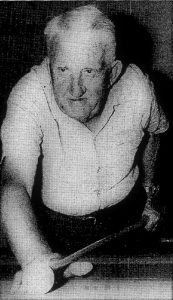
William Dickenson (1971)
More information about William and Ellen is located at – https://alhs.com.au/local-history/pioneer-graves/grave-of-william-dickenson/
In 1987, the Werribee Council undertook the redevelopment of a section of Altona Meadows located south of Central Avenue and east of the Bruce Comben Reserve, extending through to Merton Street. The streets in this area were renamed in recognition of the contributions made by former and current residents of Laverton to their community. Seven residents were chosen for their role as Councillors of the East or Altona Riding of the Werribee Council. One of these councillors was Frederick Ian Douglas.
Frederick Ian Douglas was elected by the Altona residents on 16 August 1946 and served as one of the tree councillors representing them, the Altona Riding, on the Werribee council until 24 August 1950. This was a time that Altona was growing, more residents were moving into the area and the Commonwealth Oil Refinery had established itself in the area. Altona’s relationship with both the Werribee council, who oversaw the area, and the neighbouring Williamstown council was shifting. The residents of Altona believed they should seek approval, from the State government, to stand on their own and form their own council. It was a time that strong, thoughtful, and informed councillors were needed to manage in this pending change.
Frederick Douglas was born in 1907, in South Yarra, to parents George William Douglas and Annie Gertrude Douglas (nee Fry). Frederick was the third youngest of twelve children born to the couple. Frederick’s father was a firefighter which seemed to see the family move frequently to various suburbs around Melbourne. In around 1912, his job saw him and the Douglas family move to the suburb of Williamstown. Frederick would have therefore completed his primary education within Williamstown before undertaking training to be a carpenter. However, when young Frederick was fifteen years old, his father passed away just short of his fifty-first birthday.
Frederick remained in Williamstown, living with his mother and siblings, until in 1926 he married Vera Margaret Elizabeth Skinner, the daughter of Herbert George Skinner and Lille Marguerita Catherine Skinner (nee Bendell) of Altona. Following their marriage, the couple chose Altona to live and purchased land in McBain Street. In these times, most residents built their own dwellings, and as a carpenter it would be reasonable to believe that Frederick did as well. Frederick and Vera had three children, all boys, and so quickly became engaged in the broader community, its activities, and its progress.
Eventually this would have enticed him to put is name forward, in 1946, to stand for election to council and represent his fellow Altona residents and ensure that their needs were being considered and catered for by the Werribee council and its budget. Frederick represented the residents for four years before he decided that his need was more needed with his family and work. Frederick and Vera were long term residents of Altona remaining in McBain Street well into retirement. Frederick passed away in January 1980 at the age of seventy-six and was survived by his wife, Vera and two of his sons. Vera passed away just three years later in January 1983.
Name: DUGGAN, MELVILLE HAROLD
Service: Australian Army
Service Number: VX125108
Date of Birth: 22 September 1924
Place of Birth: MELBOURNE, VIC
Date of Enlistment: 22 Apr 1943
Place of Enlistment: WATSONIA, VIC
Next of Kin: DUGGAN, ROSE
Date of Death: 07 May 1945
Rank: Private
Posting on Death: 2/23 AUSTRALIAN INFANTRY BATTALION
If you would like to know about Private Melville Duggan please follow this link https://alhs.com.au/wp-content/uploads/2024/02/Duggan-Court-edited.pdf
The SS ‘Edina’ was the longest serving screw steamer in the world and is one of the most remembered vessels that plied the waters of Victoria’s Port Phillip Bay, and it is this ship that lends its name to Edina Grove.
The SS ‘Edina’ was a screw steamer, built by Barclay & Curle, in Glasgow, Scotland, in 1854. ‘SS’ being an abbreviation for ‘Screw Steamer’ signifying that she was propelled by a steam engine rotating a single propeller, or ‘screw’ as it was known at the time. Her active service included the North Sea trade, ‘Crimean War’ (1855), Victoria’s west coast run, New Zealand to Melbourne trade, Queensland coastal trade, and of course, the Port Phillip Bay runs between the years 1880 to 1938.
Less than a year after her launch, the Edina was requisitioned by the Royal Navy and became the HMS Edina and used to carry ammunition, horses, stores and supplies from Deptford, UK to the Black Sea. A year later she was returned to her owners (Leith, Hull & Hamburg Steam Packet Co Ltd) and renamed SS Edina and returned to her cross channel runs to Europe.
 In November 1862 she was purchased by T. Callender & A. Walker of Melbourne, and after having her ‘screw’ removed sailed to Australia, arriving in Melbourne in March 1863. She was then on sold to Stephen G Henty who put her into service sailing from Melbourne to Warrnambool and Port Fairy and here commenced her checked history of collisions and near disasters.
She was at anchor in Lady Bay, Portland, on the 18 April 1863 when a tremendous gale sprang up in the early morning from the south-east, and for several hours the Edina was in a perilous position. Throughout that day huge waves broke over the vessel as she lay on the beach, and doing much damage to her bulwarks and fittings. Three days after her stranding – the Edina was afloat again. Temporary repairs were effected and the steamer left for Melbourne via Warrnambool.
On 30 April 1869 the SS Edina struck ‘Lonsdale Rock’ at The Rip at the entrance to Port Phillip Bay, with many passengers, 120 pigs, bales of wool, and a full cargo of dairy produce on board. Only one week earlier, the Clipper ‘Hurricane’ struck the same rock. The SS Edina was very lucky to survive and after passing through the Heads she headed onto Williamstown with pumps working during the entire passage up the bay. After being repaired and getting into good working order, after her narrow escape at Point Lonsdale, she had another serious mishap on her passage from Warrnambool (17 June 1869). She entered Port Phillip Heads about half past five on the morning of the 19 June, a bleak winter’s morning and had calm weather up the bay until nearing Point Cooke, when it became thick, and in a few minutes the steamer was in the midst of a dense winter’s fog. While going at full speed she grounded in shoal water on Point Gellibrand, fortunately she took the ground near where the mud punts deposited the sludge and silt dredged from the Yarra, and the bottom where she embedded herself was soft, with no rocks. With the assistance of the tug Resolute, she was freed and continued to port.
In October 1873, after running a trial trip in Port Phillip Bay, the SS ‘Edina’ resumed the coastal run to the western ports of Victoria under the command of Captain J. F. Featherstone. Unfortunately it was during this voyage that Captain Featherstone fell ill and sadly passed away. In 1875 the Edina went to Queensland to transport trade along the Queensland coast, but returned to Melbourne to complete trade within Port Phillip Bay between Melbourne, Geelong and Portarlington.
On the 29 April 1898 the SS ‘Edina’ collided with the SS ‘Manawatu’ off the Gellibrand lightship, near Williamstown, sinking the latter ship. The Edina was making her usual trip from Geelong to Melbourne with about 70 passengers aboard, most of whom were women and children, and the Manawatu was proceeding out of the Bay to the West Coast of Tasmania, and was also carrying passengers. Whilst the Edina suffered serve damage she was able to be returned to Williamstown for repairs. It was only a year later that the Edina, on her way to Geelong and the Excelsior, coming up the bay to Melbourne struck in a thick fog that hung over the Bay. The Edina struck the Excelsior on the port side amidships, and the Excelsior sank within a quarter of an hour. The Edina is almost uninjured, but she will be immediately placed in dock to be again checked over.
The next sixteen years, until July 1924 were reasonably uneventful for the Edina, but in that month she ran aground near Williamstown during thick fog as she bore down on a reef near the Gellibrand pile light. Then on the 10 August 1928 the Edina struck the tug ‘Hovell’ at the entrance to the Yarra River, and sank the tug. She remained in service until 1938 and then sat idle for approximately a decade, when in 1948, at the grand age of 94 she returned to active service. Finally, in 1957 Gilberts (Asia) Agency (Victoria) Pty of Melbourne acquired the SS ‘Edina’. She was broken up at Footscray, and her remains beached at Coode Island, aged 103.
Bibliography
- Portland Guardian’ (Vic) – Romance of the Edina – World’s Oldest Screw Steamer, 30 June 1941
- Geelong Advertiser (Vic) – 29 Sep 1899
- Geelong Advertiser’ (Vic) – Mishap to Edina, 11 July 1924
- Argus’ (Melbourne, Vic) – Article Edina to Serve Again 9 July 1948
- Mercury (Hobart, Tas) – Shipping Disaster off Williamstown – Edina & Manawatu in Collision – Sinking of the Manawatu – Edina Stranded – No Lives Lost, 29 April 1898
- Bathurst Free Press & Mining Journal’ (NSW) – Collision in Port Phillip – The Edina Sinks the Excelsior – All Hands Saved – Melbourne, Tuesday, 12th July 1899
- Age (Melbourne, Vic) – Edina’s Last Yarra Trip – 16 Jul 1938
Research: Graeme Reilly (Altona Laverton Historical Society)
In 1987, the Werribee Council undertook the redevelopment of a section of Altona Meadows located south of Central Avenue and east of the Bruce Comben Reserve, extending through to Merton Street. Some of the streets in this area were renamed in recognition of the contributions made by former and current residents of Laverton to their community. Seven residents were chosen for their role as Councillors of the East or Altona Riding of the Werribee Council. One of these councillors was Frederick Albert William Emery.
Frederick Emery was elected as a councillor representing the residents of the Altona Riding, of the Werribee council, on 23 August 1945 and served on councillor until he retired on 5 April 1951. He also served as the Werribee Shire President in 1947/1948. Frederick and his wife, Ivy Elizabeth Emery (nee Newton) had married at St John’s Church of England in the border town of Corowa on 6 November 1937. Frederick had been a farmer within the Benalla district, but following their wedding the couple moved to the Melbourne suburb of Altona to establish their new family home. Here the couple settled into their new community, like a lot of people moving into the area, by becoming involved in local issues, concerns and groups.
By the end of the second world war, Fredrick Emery had ingrained himself into local affairs and in particular Altona’s move away from the control of Werribee. In 1945 he put his name forward as a local councillor and was elected serving alongside the likes of John Kenneth Grant and Frederick Douglas. In the third year of his term, Frederick was appointed as the Shire President. During his second term as councillor, Frederick and other Altona Riding councillors began to push to the succession of Altona away from Werribee. By now the Commonwealth Oil Refinery had been established in Altona North and were contributing £4,000 to the council’s income, but it was felt that very little of this was coming back to benefit the people of Altona in the way of better roads, paths and amenities.
Early in 1950, Werribee learned that Williamstown had re-applied to annex the Vacuum refinery area, and ‘outright war’ was declared between the two municipalities. Arguments were presented to a government inquiry in May. Williamstown said it would insist that the refinery contribute largely to the upkeep of roads in the area, and ‘do something about pollution of the creek and the beach’. Werribee pointed to Williamstown’s absolute lack of modern planning. Some months later, Councillor Emery chanced to hear talk in a local hotel between a couple of Williamstown councillors. He deduced that they considered Altona annexation to be a certainty, although neither Werribee nor Shire Secretary, J.P. Muirhead, had heard a whisper.
Councillors Grant, Emery and Moore decided on prompt action and called at John Lemmon’s home to enlist his help. On learning that parliament was sitting, they drove straight on to Spring Street, where they saw all three local State members. Their day had ended with late night arrangements for a public meeting in the Altona RSL Hall on Monday 18 September. To arouse support, Emery toured Altona with a public address system attached to his car. The crowd was estimated at between 800 and 900 people when the local population was only a few thousand. One-third of them could not fit into the hall and listened as best they could from outside. The parliamentarians who attended were struck by the unanimity. Minister Byrnes announced that he ‘would not dare sign the transfer of this riding to Williamstown or anyone else in the face of this opposition’.
However, Frederick Emery did not wait around, in Altona, to see the fruition of his hard work as in 1951 he resigned as councillor resigned to take up a hotel licence at Jindabyne in the Snowy Mountains where the massive hydro-electricity scheme was being constructed. His replacement as riding councillor was Walter Carruthers. Frederick and Ivy Emery operated the Jindera Hotel through the 1950s but towards 1960 sold up and moved to south of Brisbane, Queensland and the town of Redlands Bay. Here Frederick took up fishing at the age of fifty-three. The couple had been living there for about nine years when Frederick Albert William Emery passed away on 14 December 1969 and he was buried within the Redlands Bay cemetery. It was due to his work that Altona not only broke free from Werribee but avoided the clutches of Williamstown council to form its own local government that cared for the prosperity of the suburb and the welfare of its residents.
Shortly after, Ivy Elizabeth Emery moved back to the New South Wales/Victorian border town of Albury where she lived until her passing on 23 December 2002. Ivy is buried within the Glenmorus Memorial Garden cemetery in Albury.
Not only is there a Emery Court in Altona Meadows, but there is also Emery Court in Altona, near the F A Emery Reserve, located in Green Court.
While the Everingham family tree can be traced back to England, the story behind Everingham Road actually begins in the USA. Jeremiah Everingham, originating from England, was possibly the first of the Everinghams to move to and live in the United States. Jeremiah lived with his family in New Jersey from the early 1700s.
A few generations on, some of Jeremiah’s ancestors remained in New Jersey, but others had also spread to New York, one of which was Gilbert Delaplaine Everingham. He was born 15 August 1818 in Dover, New York.
Gilbert Delaplaine eventually travelled to Sydney, Australia in 1854. His two sisters remained in the USA, one staying in New York, and the other moving to Ohio. Gilbert Delaplaine married Hannah Maria Fox in Sydney on 23 January 1856, with the couple having their first child, Margaret, later that same year.
The couple’s final child, Gilbert John Everingham, was born on 11 February 1871, in Ross, Hokitika, New Zealand. It is unclear when or why the family moved from Sydney to New Zealand. By 1885 however, the family had returned to Australia, now residing in Melbourne.
Prior to 1903, Gilbert John, now in his early thirties, had moved to Broken Hill, NSW. He married Margaret Forbes on 25 March 1903. The couple’s first child Margaret Ethel Eleanor Everingham was born on 4 August 1904.

Margaret (Forbes) and Gilbert John Everingham
The couple’s second child, Gilbert Archibald Everingham, was born on 7 August 1905. The family moved frequently, and they were now living in South Australia, first in Adelaide and then Yorktown. During this time in South Australia, the couple had three more daughters: Jessie (b.1908), Iris (b.1910) and Hazel (b. 1912).
Prior to 1928, the family had once again moved interstate, having moved to Altona, Victoria, with the Everinghams owning a book shop on Pier Street. In 1928, the store was advertised in the 4 October edition of the local newspaper, the ‘Werribee Banner’ (which you can see below!). The store was further advertised in two editions of the Werribee Banner in January 1932.

Ad in Werribee Banner 4 October 1928
In 1928, Gilbert Archibald enlisted in the air force. He received an MBE award for his military service, in London, in August 1943, with his achievement being shared in both the ‘London Gazette’, as well as ‘The Argus’ in Victoria.

In 1929, sisters Jessie and Iris also became members of the Altona Life Saving Club, a community-run organisation that still operates today. The club is dedicated to educating community members about safety in the water and first aid skills, making Altona Beach a safe location that all can enjoy. If you want to learn more about one of the founding members of the Live Saving Club, follow this link (https://alhs.com.au/dukes-paproths/) to further information on our website!
In 1932, Gilbert John was elected as the President of the Altona Progress Association, with the news appearing in the 11 February edition of The Age that year. Coincidentally, this was his 61st birthday, and a very memorable one at that! Again, if you want to immerse yourself in Altona’s rich history, follow this link (https://alhs.com.au/local-history/clubs-and-associations/) to discover more about the Altona Progress Association!
Now that you’ve learnt about the Everingham family, what about the road that shares their name? According to the Hobson Bay City Council’s ‘Neighbourhood Profile’ of Altona Meadows, it Is suggested that significant development of the Altona Meadows area did not begin until the mid-to-late 1970s.
During this period, Everingham Road was constructed, being connected to Victoria Street. The road appears in the 1977 Melway street directory of Greater Melbourne, though it may have been established a few years earlier. Everingham Road was further extended by the early 1980s (to its current length), now connecting all the way to Queen Street, which can be seen in the 1982 Melway.
The Everingham family clearly had a significant impact on their local community, and so, in recognition of their many achievements, Everingham Road was named after them.
Research: Adam Virgona and Graeme Reilly (2022)
Written by: Adam Virgona (2022)
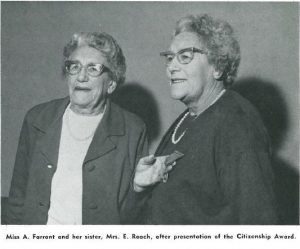
Alice Farrant with her sister Edith Roach
Farrant Court is located in Altona Meadows, where a great number of streets are named after prominent families who lived in and contributed to the progress of the wider Altona area. The Farrant family moved to Altona around the early 1930s, initially living in Curlew Avenue, before moving to the Esplanade. The Farrant family included Albert George Farrant, his wife Ada Mary Merrifield Farrant (nee Hargreaves), and daughter Alice Merrifield Farrant. Alice’s younger sister, Edith Ada Roach (nee Farrant), was already living in Altona as she had married RAAF Engineer Eric Athelston Roach some three years earlier.
It is predominately Alice Merrifield Farrant’s contribution to Altona for which Farrant Court is named after. Following her secondary schooling, Alice trained to become a teacher, commencing her long career in 1914. She was first appointed to a school in West Melbourne in 1917. Alice then moved to schools in country Victoria including Frenchmans, which is located north-east of Avoca, San Remo, and Corack, north of Donald, before being transferred to North Melbourne. Around 1932, Alice was transferred to Altona and she took up residence in the town living with her parents. This was to be her last transfer as her teaching position at the Altona Primary School lasted for 30 years.
It was not long after taking up her new teaching position that Alice heard about and became involved with the new Altona Community Hospital. She took on the role of Membership Secretary in 1933 when the hospital was situated in Pier Street. Her involvement may have been something to do with Charles Borrack, who also taught at Altona Primary, and was a leading force on the forming of the hospital committee. You can read more about Charles, and his wife Mary, following this link: https://alhs.com.au/local-history/pioneer-graves/grave-of-charles-william-borrack/
Alice remained on the Board of Management until the end of the 1975, working for many years alongside her sister Edith Ada Roach (nee Farrant). She ultimately dedicated just over 42 years of service to the hospital, including a brief period as the Board President in the 1940s. It is an incredible feat that any one person would devote so many years of her life to better her community, serving both the hospital and school faithfully. In 1960/61, her achievements were recognised, and she was awarded a Life Governorship.
In 1975, Alice resigned from her position due to ill health, and she moved to the Prahran/Windsor area to retire. She passed away in November 1978. Alice Merrifield Farrant was cremated at the Springvale Botanical Cemetery after a life of service to her community, where her generosity of spirit was an inspiration to all.
Research: Graeme Reilly, Editing: Adam Virgona
In 1987, the Werribee Council undertook the redevelopment of a section of Altona Meadows located east and west of the Bruce Comben Reserve, south of Central Avenue. The streets in this area were named in recognition of the contributions made by former and current residents of Laverton to their community. One of these is Fitzpatrick Drive named in recognition of the contribution of Desmond Peter Fitzpatrick, and Jean Beryl Fitzpatrick, to the Laverton community.
Desmond (Des) Fitzpatrick was born in Carlton, on 12 April 1922, and spent much of his childhood days in the seaside suburb of Chelsea. He was the third born of five children, four boys and one girl. From an early age Des was very sporting motivated, being interested in football, cricket, swimming, and boxing. He was the Victorian Junior boxing champion at the age of 13 years, and later the Victorian Police boxing champion.
Initially educated at St. Peters and St. Pauls schools South Melbourne and then St. Josephs in Chelsea, Des left school at the age of fourteen and worked as a metal polisher until 1941. With the outbreak of World War 2, Des joined the army and served overseas as a transport driver. Following the war, he returned to his previous employment and in 1948 he married Jean Beryl Harris, in Footscray in 1948. In May 1948 he joined the Victorian Police Force and after completing his training he served at Footscray, Coburg, and Reservoir stations before being transferred to Rushworth (1961) as the Officer in Charge.
Des was stationed at Rushworth for just over seven years, and during this period not only did he set exacting standards of Police work but has again been continually active in community affairs. He was a youth leader, coach of the junior cricket team and RSL President. In fact, both he and Jean were highly respected members of the Rushworth community and a loss when in October 1968 he was transferred too the Laverton Police station.
Again, not only has Des set a high standard of Police work but was continually active within Laverton community affairs. He joined the local Rotary club, served on the High School Committee, was the foundation president of the Laverton Bowls Club which was his greatest personal achievement with his untiring efforts in working towards its foundation in 1974/75. In 1972 Des was promoted to the rank of Senior Sergeant and remained the Officer in Charge at Laverton.
In 1982, after a distinguished career spanning thirty-four years, Des retired from the Police Force, but he and Jean remained living in Laverton and continued their service to the community that they had grown to love. Both Des and Jean continued their service to the Laverton Bowls Club and their love of the sport.
Research: Graeme Reilly (ALHS 2025)
In 1987, the Werribee Council undertook the redevelopment of a section of Altona Meadows located south of Central Avenue and east of the Bruce Comben Reserve, extending through to Merton Street. The streets in this area renamed in recognition of the contributions made by former and current residents of Laverton to their community. Seventeen residents were chosen for their role as Officers in Charge of the RAAF Bases at Point Cook and Laverton. One of those honoured was Group Captain John Gordon Gazley.
John Gordon Gazley was born in Mildura on 26 December 1937 and spent some years in Bendigo before the family moved to Warrnambool when John was seven. After matriculating at the Warrnambool High School, he enlisted with the RAAF as an Air Cadet at RAAF College Point Cook in January 1956 and graduated as a navigator in 1960. His wife, Gloria Elizabeth, was born in Rawalpindi into a military family and moved to the UK when India was partitioned in 1947. She completed her schooling in Plymouth and then trained as a nurse at the London Hospital. In 1960 she came to Australia on a working holiday during which she obtained her midwifery certificate from the Townsville General Hospital.
John’s first operational posting was to No 10 Squadron in Townsville, first on Lincoln and then on the Lockheed SP2H Neptune Aircraft. In 1967 he transferred to the strike role on Canberra’s and served with No 2 Squadron at Phan Rang South Vietnam in 1967/68.
His association with the F 111 commenced in 1968 and was renewed in 1973 when, as Navigation Officer of No 1 Squadron when he ferried two aircraft from the United States to Australia and subsequently contributed to the operational introduction of the F 111 C into the RAAF service. In 1977, John Gordon Gazley was awarded the National Medal[1]. From 1980 to 1982 he was the Commanding Officer of the School of Air Navigation at East Sale, and in 1983 served as Assistant Commandant of the RAAF Staff College in Canberra. He took up his appointment as Officer Commanding RAAF Laverton in December 1984.
Group Captain Gazley has undertook several staff jobs at Air Force Office, Canberra, mostly in the fields of operations research and operational requirements. He is a graduate of the RAAF Advanced Navigation Course, the RAF General Duties Aerosystems Course, RAAF Staff College 2nd the Joint Services Staff College.
In 1982 he obtained a Degree in mathematics from the University of Queensland. In July 1990 Group Captain John Gazley was awarded a Third Clasp to the Defence Force Service Medal.
In the 1993 Australia Day Honours, Group Captain John Gazley received an Order of Australia medal for service to the Royal Australian Air Force as Senior Plans and Policy Staff Officer Air Headquarters.
[1] The National Medal is Australia’s most awarded civilian medal. It recognises long and diligent service by members of recognised government and voluntary organisations that risk their lives or safety to protect or assist the community in enforcement of the law or in times of emergency or natural disaster.
In 1987, the Werribee Council undertook the redevelopment of a section of Altona Meadows located south of Central Avenue and east of the Bruce Comben Reserve, extending through to Merton Street. The streets in this area renamed in recognition of the contributions made by former and current residents of Laverton to their community. xxx residents chosen for their role as being Councillors of East and Altona Riding of the Werribee Council. One of these streets was named, by council, to honour Francis (Frank) Joseph Gibson.
Francis Gibson was born 2 September 1917, but little is known of Francis’ biological parents, but shortly after his birth, Henry (Harry) Gibson and Elizabeth Gibson (nee Lambert) fostered Francis. This may have occurred after the death of their daughter, Gladys Myrtle Elizabeth Gibson, in November 1917. Within three years, the family had moved to Trafalgar area, Gippsland, where Elizabeth passed away on 24 June 1928. The family remained living and working in the area. Having completed his education, Francis Gibson gained employment as a truck driver.
When the second World War commenced, Francis Gibson enlisted into the army on 22 June 1940, in Trafalgar and served with the 152 Australian General Transport company, seeing action in New Guinea and the Solomon Islands. Francis served until his discharge on 22 October 1945. He returned to his family who were now living in Torrensville, South Australia.
Around 1950, Francis Gibson moved across from South Australia to Victoria and settled in the Laverton area. We are not sure as to the reason for his move to Laverton, whether it was due to the prospects of better employment or family. It was also at this time that he met and married Leila Mary Cheetham (nee Matheson). Leila had been married to Theodore Stanley Cheetham, who had passed away in 1948. Theodore was the son of Richard Cheetham, founder and owner of Cheetham Saltworks that operated in Laverton.
Francis and Liela Gibson settled to life in Laverton and Francis became involved in community life, sport and public affairs. Francis Gibson joined the Laverton Cricket Club, and his association with this club lasted more than 30 years. He became the first Honorary Life Member of that Club, as well as a Life Member of the Laverton Football Club with which he was involved either as a player or in an administrative capacity. He held either the Office of President or a Committee member of the Laverton Progress Association for at least 15 years and was an active participant in the Epsom Street Primary School Council assisting in the endeavours to improve the facilities at the school.
Francis also served the residents of Laverton as an East Riding Councillor, on the Werribee Shire Council, from 1962 to 1968 and again from 1971 to 1972. He was a man with a large community spirit and was one of the first to step up when things needed doing.
Sadly, Francis Joseph Gibson passed away on 15 April 1984. This was just two months after his serve to his community had been honoured, by the Werribee Shire Council, who named the park sitting between Allen and Sumers Streets in Laverton the Frank Gibson Reserve. The unveiling ceremony took place on the evening of 17th February, attended by the Gibson family, friends, the Shire President, and several Councillors. Some four years later, Francis Gibson was again recognised with the naming of Gibson Court.
Research: Graeme Reilly (ALHS 2025)
In 1987, the Werribee Council undertook the redevelopment of a section of Altona Meadows, located south of Central Avenue and east of the Bruce Comben Reserve, extending through to Merton Street. The streets in this area were renamed in recognition of the contributions made by former and current residents of Laverton to their community. Seventeen residents were chosen for their roles as Officers in Charge of the RAAF Bases at Point Cook and Laverton. One of these was Group Captain Henry Talbot Hammond.
Henry Talbot Hammond was born on 1 October 1893[1] in Bondi, New South Wales to parents John Hammond and Amelia E Hammond. From 1907 to 1912 Henry was educated at Sydney Grammar School in Darlinghurst. When the war started, Henry was doing an engineering course at Sydney Technical College. His father had wanted him to go to university, but Henry preferred to go to college as it allowed him to study at night and work in a motor repair shop during the day.
Henry was an only child, so naturally his parents were anxious about him enlisting, but all his friends were joining up, and Henry didn’t want to be left behind. He enlisted into the army in 1915, but when the time came for Henry to be shipped away to Egypt as a reinforcement for the 13th Battalion, a routine medical inspection before embarkation discovered that he had contracted measles. Henry was hurried off to hospital in Liverpool, whilst the rest of his friends were shipped off to the war. Henry eventually got to Egypt, sailing on the HMAT Ballarat and was drafted into the 54th Battalion, stationed at Tel-El-Kebir. Here, they undertook extensive training and acclimatising to the heat, which did not prepare them for their next destination on the Western Front in France.
Henry and the 54th Battalion were soon shipped to France, where they were transported into the line in Belgium, near Armentieres. On 19 July 1916, the whole division took part in the battle of Fromelles. They went over the top at 6 pm on a summer evening. The artillery barrage was tremendous, and they had about five or six thousand casualties in the division within twelve hours. Fortunately, Henry was not one of them, though he was still severely wounded in the leg and head by shell splinters. After being taken to the casualty clearing station, he was moved to an advanced hospital and later evacuated to England, arriving at a hospital in Birmingham. When he had recovered, Henry reported back to the reinforcement camp on Salisbury Plain. It was while he was there, a notice appeared in the Orderly Tent, calling for volunteer cadets for the Royal Flying Corps and Henry decided to apply.
He was interviewed by a General, who by coincidence was, like himself, an old Sydney Grammar boy, which may have gone someway in seeing him being accepted as a cadet. The official reason may have been more along the lines that Henry had been a machine gunner in the infantry and had some engineering experience behind him. To start his new role, Henry received instructions to report to Adastral House, London and was transferred across to the Royal Flying Corps. Initially, Henry was posted to a training camp at Denham, and then spent two months at Brasenose College, Oxford University. Here, he learnt about rigging, machine guns, Morse code, deflection shooting and signals. Then, at the beginning of 1917, Henry was posted to Netheravon Flying School, where he had the opportunity to fly all the most modern aircraft of that time.
After finishing his training at Upavon, Henry returned to France, with his first stop being at St. Omer, which was a depot for pilots waiting to be drafted to the various squadrons. Eventually, Henry found himself on his way to 60 Squadron, which was stationed at Izel le Hameau. After chasing German observation aircraft and spotting enemy position for a time, it wasn’t long after that the squadron moved to Marie Capelle, just behind Ypres. From here, the squadron worked the Cambrai Lens sector. Whilst there, on 15 September 1917, Henry was due to take off on a mission but was advised that his plane was ‘unserviceable’, so he was grounded. However, quite soon after his fellow squadron members took to the air, Henry was advised his plane was now ‘okay’ and that he should take off, which he did.
Before Henry could catch up to his formation, his plane developed engine trouble which steadily became worse, and he began to lose height. Deciding he should try getting back to base, Henry turned around and almost immediately two German scout planes appeared. In attempting to avoid the planes and nurse his failing engine, Henry was forced to crash land and was captured by German ground troops. In Douai, he was locked up in the top room of the local Bank of France building, for about a week. He was later joined by an English officer by the name of Shadwell, who had been shot down and captured.
Eventually, Henry was moved to an officer’s camp at Clausthal, which was high in the mountains and terribly cold in the wintertime. Unfortunately, those held there had very little winter clothing and needed to sew hessian and newspaper together with string, to make blankets and keep the cold at bay. Here, with nine other POWs, Henry dug a tunnel with a frying pan handle in preparation for an escape attempt. However, the tunnel was discovered, and the prisoners were punished with solitary confinement. The incident gave him the nickname ‘Bunny’ which stayed with him for the remainder of his life. After being freed from the camp, Henry and the other POWs went up to the Baltic by train, and then to Copenhagen by tugboat. From there, he went across to Scotland, before being returned to Australia.
After the war, Henry continued to work in the aviation industry but rejoined the Royal Australian Air Force in 1925, completing a refresher course at Point Cook. By 1928, he was senior manager and chief flying instructor of the NSW Aero Club. He believed that anyone could learn to fly in just five weeks. After this, Henry was part of the Citizen Air Force for quite a long time while living in Richmond, NSW. During the 1930s, Henry also undertook a lot of flying in New Guinea, mostly carrying in heavy freight.
Henry later served with the RAAF during World War II, having been called up on the second day of the war. He commanded No. 2 A.0.S. Navigation School in Mount Gambier, then was the flying instruction as a Group Captain in Richmond, NSW. After another spell in New Guinea, Henry became Station Commander in Laverton, Victoria. He soon rose through the ranks to become Wing Commander and received an OBE in 1943 as part of the King’s Birthday Honours. In 1945, Group Captain Henry Talbot Hammond retired from the Royal Australian Air Force. Henry passed away on 28 September 1982, aged 88 and was interred within the Northern Suburbs Memorial Gardens and Crematorium in North Ryde, NSW.
[1] Records at Births, Deaths and Marriages NSW note registration year of his birth as 1893, but other writings suggest that it was 1895. His enlistment papers for WW1 indicate 1893, but his WW2 records indicate 1895.
Huia Close was named after another ship that is linked to the Truganina Explosive Reserve and the Altona Bay area. The Huia was built in 1894 as a timber carrier, by James Barbour, at Aratapu (popularly known as Barbour Town), Kaipara Harbour, New Zealand, for Messrs. E. Mitchelson & Brothers. James Barbour was a multi-talented craftsman and seaman and Huia was his largest ship.
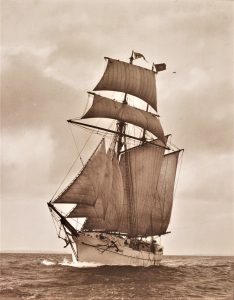 The Huia remained on the Kaipara – Lyttleton run, in New Zealand, until 1912. She was then purchased by the Nobel Explosive Company for the trans-Tasman run, to carry explosives and general cargo. For safety reasons, the benzine engine was converted to kerosene. It was around this time that she began her service from the Truganina Explosive Reserve.
In 1917, Huia returned to Australia. After arriving in Melbourne from Auckland, she continued on to Hobart, making the crossing in a record 48 hours. Later in the same year, the Huia made the longest ocean crossing of her career, from Auckland to San Francisco with a load of copra and rubberoid roofing.
Huia became a favourite vessel in Australian waters from Cairns to Fremantle. Her owners kept her in top condition and under the command of excellent captains.
The Huia has given good service for many years and is the proud holder of the sailing ship record passage between New Zealand and Melbourne. She also does the Bunbury-Melbourne trip in favourable weather in less than nine days.
During her 57 years of service, the Huia experienced stormy passages, near disasters, lucky escapes from death and some tragic losses of lives. On January 20th, 1949, at age 55, the Huia was paid off. In early 1950, she was sold to the newly formed Huia Trading Company, registered in Suva, and put into service carrying passengers and cargoes between the south sea islands. At 1:00pm on January 26th, 1951, Huia sailed from Port Noumea for Vila with a pilot to take her through the hazardous Woodin Canal and Havannah Passage. At 7:30pm, the pilot was taken off, leaving the schooner just inside the reefs but with a clear passage ahead. With the change of watch at 8:00pm, the course was altered, it being thought that the reefs were cleared. At 8:42pm, the Huia came to a grinding standstill on Komekame Reef on the southern side of the Havannah Passage.
The next morning she was full of water. In spite of pumping and jettisoning cargo, she lay hard over on her port bilge at high tide and there was no way that she could be towed over the underwater ledge. The decision was then taken to abandon her. No sooner had the last three crewmen been taken into the lifeboat than a swell lifted the schooner and then dumped her onto the top of the starboard anchor, stoving her in. In the days that followed, she held together as her cargo was salvaged and plans were made to fill her hold with empty drums in the hope of floating her off, but she started to break up – and then fire took a hand again. Huia was burnt to the waterline and a few days later an intense cyclonic storm swept her away. The last sailing ship to be used in the trans-Tasman trade was gone.
Back in the 1800’s at Mornington, a small seaside town on the Mornington Peninsula in Victoria, Australia, the main event of the day was the arrival of one of the Paddle Steamers at the Mornington Wharf. The local hotels and guest houses sent wagonettes and porters to the pier to escort guests to their establishments. When the paddle steamers departed to continue their journey to Sorrento, a procession of porters, trolleys and passengers headed towards the Main Street.
Paddle Steamers were a luxury form of transport on Port Philip Bay in the late 1800’s. They were used to transport tourists from Melbourne to Mornington, Dromana and Sorrento on the Mornington Peninsula, and Queenscliff on the Bellarine Peninsula.
By the turn of the century, there were 3 Port Phillip Bay paddle steamers in operation, the Ozone, the Hygeia and the Weeroona.
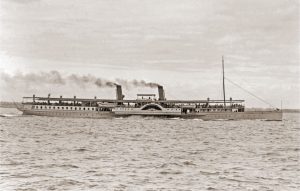 The Hygeia was built by Napier, Shanks and Bell of Glasgow in 1890 for Hubbart Parker and Company, and was designed to compete directly with Ozone. She was 300 feet long (92 metres), built of steel and weighed 986 tons. She was capable of 22 knots under full steam and considered the most luxuriously appointed paddle steamer ever built for Australian service.
Licensed to carry over 1600 passengers, Hygeia operated for 40 years servicing Port Philip Bay. She had a promenade deck, licensed saloons, luxuriously appointed dining rooms and a barbers shop. The Hygeia was taken out of service in 1930. During her time she was involved in a few incidents. In 1894 she was involved in a collision with the tug, Sprightly and then on the 8th December 1911 she collided with an unnamed cutter on Port Philip Bay and a few days later on the 22nd December was stranded at Sorrento.
The Hygeia was laid to rest after being stripped of all her fittings at Barwon Heads just outside the western head of Port Philip Bay in June 1932.
Research: Graeme Reilly (Altona Laverton Historical Society)
Investigator Grove is named after the HMS Investigator that in 1802, under the command of Matthew Flinders, became the first ship to circumnavigate Australia. Investigator set sail from Spithead for Australia on 18 July 1801, calling at the Cape of Good Hope before crossing the Indian Ocean and sighting Cape Leeuwin off Southwest Australia on 6 December 1801. The expedition put into King George Sound (Albany) for a month before beginning a running survey of the Great Australian Bight, which stretched 2300 kilometres to Spencer Gulf.
On 21 February 1802 a tragic accident occurred when a shore party which included Ships Master John Thistle, midshipman William Taylor and six seamen were lost when a boat capsized attempting to return to the ship at dusk in choppy waters. No bodies were recovered. Flinders named the headland Cape Catastrophe, and the area which he had anchored Memory Cove.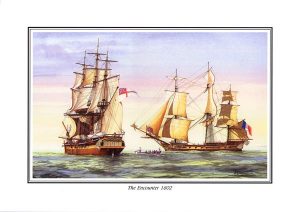
Proceeding into the gulf, Flinders surveyed Port Lincoln (which he named after his home county in England). Working eastwards, the HMS Investigator next charted Kangaroo Island, Yorke Peninsula and St Vincent Gulf. On 8 April, at Encounter Bay, a surprise meeting with ‘Geographe’ under the command of Nicolas Baudin was cordial, the two navigators being unaware the Treaty of Amiens had only just been signed, and both still believing that their two countries were still at war.
Sailing eastward through Bass Strait, ‘Investigator’ visited King Island and Port Phillip (hence its link to the area) before continuing along the east coast and arriving at Port Jackson on 9 May 1802. Investigator spent the next ten weeks preparing and took aboard 12 new men, including an aborigine named Bungaree with whom Flinders had previously sailed on the sloop Norfolk. On 22 July Investigator left Port Jackson, sailing north in company with the brig Lady Nelson, however the Lady Nelson sailed poorly after losing her keels and Flinders ordered her back to Port Jackson.
Investigator hugged the east coast, passed through the Great Barrier Reef and transited Torres Strait. Flinders did complete the circumnavigation of Australia, but not without the need to lighten the ship by jettisoning two wrought-iron anchors. These were found and recovered in 1973 by divers at Middle Island, Archipelago of the Recherche, Western Australia.
Prior to being named the ‘Investigator’ the ship was known as ‘Fram’ and served for about three years as a collier before being purchased by the Royal Navy.
Research: Graeme Reilly (Altona Laverton Historical Society)
In 1987, the Werribee Council undertook the redevelopment of a section of Altona Meadows, located south of Central Avenue and east of the Bruce Comben Reserve, extending through to Merton Street. Several streets in this area were renamed in recognition of the contributions made by former and current residents of the district to their community, as nominated by fellow community members. Ison Court was named after the pioneer family of William Ison.
As William was among the early settlers of Werribee rather than Laverton, it is essential to offer context regarding why his name was proposed by community members as a potential street name. I feel it appropriate to start his story with a passage from William’s obituary, which tells us more about who he was, and a great deal about his standing within the district. The esteem that his fellow residents held him in is illustrated by the following passage – ‘He was a resident of the district for sixty-eight years, and during that period was well liked and respected by all with whom he came in contact. During the last few years of his life, his faith in his Redeemer, and his staunch support of his Christian principles, stamped him as a man of renowned quality. He was also the originator of a petition which was drawn up to establish the first State school in the district.’ This brief passage highlights the quality of the person, his accomplishments, and the contribution of his family to life and progress across the Werribee district. With that in mind, the following is the Ison family’s story.
Let’s step back in time to October 1832 in the England midland county of Cambridgeshire[1], and more specifically to the small village of Fowlmere, about nine miles southwest from the city of Cambridge. Edward and Mary Ison (nee Jordon) are in the first year of their marriage, expecting their first child, and working the two-hundred-acre farm that they managed for a landlord who lived some twenty miles away. On 19 October, William Ison was born and was to be the first of fifteen children born to the couple. William’s younger years were very much like other young people in rural England, undertaking primary schooling and then learning all about farming and agriculture from his father to help tend to the property. If we skip forward to early 1854, with William now aged twenty-one, life as the Isons knew it was about to change forever.
At the beginning of that year, William had little or no thought of moving to Australia, although a Victorian agent seeking immigrants was often visiting his village. However, by about July, William was walking through his village with four others his age and saw this agent coming behind them. It was suggested that one of them ask the agent for papers about going to Australia, thinking it would cause some excitement in the village. Sometimes an act done in jest can set things in motion that changes one’s destiny in life. If you have ever wondered why your relatives moved far away from their home, family and friends in England, halfway around the world to Australia, then this firsthand account from William Ison might give you a clue. While reading this, just remind yourself that the year is 1854, nearly two hundred years ago, yet young people then still enjoyed playing jokes to test their parents. Some things never change.
In 1903, when asked about this fateful day, an older William described the following –
In going home that evening, I showed the paper to my sister, Elizabeth. After reading it she said-” You go to Australia!” I asked her to show it to mother. She said no; if you want to make your mother ill then do it yourself. However, she did do it. I was soon sent for. I found my mother and father sitting in the parlour; my mother with the paper in her hand, she said “My dear boy, what do you mean by this.” I said, “don’t you see.” She said “Oh, you do not really mean it. I could not part with you; it would kill me.” Seeing that she was so much against It, I said four others of us had merely done it for a joke. That I had no intention whatever of going. She said, “Then I can burn this,” and did so. The news soon spread, and a substantial number came to see my mother daily; some of them advising her to let me go very much annoyed her. Wherever I went it was ” When are you going, and how are you going by yourself, or are you going to take a wife.” Some advising one thing and another something else, so that I got so imbued with the idea that I would have to go, I would never acknowledge that I was not going. At last, I said to my father “I cannot get this Australia out of my head.” He said ” Go; you have a hundred pounds to your credit left to you by your grandmother out of her will, a little fortune when you were only about three years old; you can now take that, and if you like I will pay your fare.”
My mother finally gave her consent to signing, and as I had to get two other signatures, I went to the largest farmers in the district who after much requesting of me staying and managing their farms also signed my papers. No sooner had I gained the signatures than my mother, and grandmother, declared that I should take a wife to take care of me. I replied, “who am I to take?” My grandma said, “There are plenty of young ladies coming here, some from the best families in the district, ask some of them. After telling my sister, Elizabeth, she said, “Well you shall not go alone, for I shall go with you.” She had already discussed the idea with her ‘intended’ and it was all agreed, even my mother agreed that I must allow my sister to journey with me. As for a wife, it appears my sister and her future husband, Frederick John Hayden, had that in hand as well, advising that that I was to meet his sister, Charlotte, on the next Saturday afternoon for tea. I found the young lady a very pleasant companion, and that she would not mind going to Australia. Not only this, but her parents not only consented to Charlotte joining us to Australia but gave their blessing to wed. Things were progressing much quicker than I had thought.
The day of 16 October 1854 was fine, and we lived only about sixty yards from the chapel and so we agreed to walk. As we neared the chapel my sister says “Oh, what a crowd.” However, they made way for us, but we had hard work to get inside. It was packed. The ceremony was a long one but passed off well. We drove to Cambridge, where we spent three days visiting friends and relatives.
The day arrived for our departure. All our relations and many friends followed us to the station. This was on the 19 October 1854, being also my twenty-second birthday. As the train came into the station all was bustle and hurry. At the last moment, my father forced into my hand five sovereigns[2], saying “You must take this, and if ever you want more let me know.” I had been saving my money for some years past and considered I would have enough till I could earn more.
We arrived in London, where we had friends to meet us, who also had provided accommodation for us for the night near where the steamer was moored, awaiting to take us on to Plymouth where our ship, Shand, was berthed. And so, our journey to Australia began.[3]
The Shand was an 836-ton sailing ship, under the command of Captain Henry Christie, that left Plymouth on 27 Oct 1854. It finally arrived at Portland, in the colony of Victoria, on 20 January 1855 after a voyage of 85 days. The ship carried 332 passengers, five of which were children that tragically passed during the voyage. William was not one to idle away his time during the journey. He often aided the crew and captain by keeping passengers amused with his singing and music, as well as with conducting Sunday Church service.
On arriving in Portland, the captain, in leaving the ship, asked William if he intended to stop here. William replied that he was, to which the captain advised that he would try getting him a place to stay and work. He returned a while later saying that he had secured three places from which William could choose. The first option was with Edward Henty[4], on a station about twenty miles inland, where the wages were £100[5] a year. The second option featured a similar setting and wages, though it was a fair bit closer, being only seven miles away. The third option were livery stables based in Portland itself, but Charlotte would have to cook for two men, Smith and Coleman, the stables’ owners. William chose the third option as wages matched the other two, and he only wanted to rent it for six months.
By the start of 1855, the population of the area was just over one thousand people, and the commercial part of town was thriving from the gold rush. However, William soon considered that there were only three or four houses in town worth calling houses, with Edward Henty’s being the best, no chapels or schools, and no one in the whole district to associate with. Life had quickly become intolerable to the newlywed couple.
They had only been there about a month, and it was one of those still Sunday evenings, when William brought out a chair to the front porch. He looked across the bay to the way they had come and thought about his home back in England. What would he give to be there in the chapel among the choir, playing his clarinet or flute. Feeling homesick, William fetched his clarinet and began playing it outside. Within a short time, and without noticing, he found about half-a-dozen people were listening to him play. He kept the crowd joyous well into the night, with all begging him to play more, though it was getting late.
Although their situation in Portland was quite favourable as newcomers to Australia, the Isons felt a longing to travel to Melbourne where William’s aunt (his mother’s only sister), Sarah Bird (nee Jordon)[6] was living. From reports William had received, Sarah’s sons were doing well at the gold diggings. They came out about four years before William, Charlotte, Frederick, and Elizabeth. After staying in Portland for about seven months, William spoke to Coleman, asking to be allowed to break his property agreement. Coleman said he could not hear about it; William suited them well, and that he should be sorry to part ways. As Edward Henty was living just opposite them, and William was housing his horses and carriage, William thought to share this news with his neighbour. After many conversations with Coleman trying to entice William to stay in Portland, in late 1855, the Isons travelled to Melbourne, where they located William’s aunt living in Fitzroy.
There was a young man boarding with his aunt, who had been to the gold diggings with his uncle, and they had returned with about £700 each[7]. They agreed to take William with them, and so after staying about a week in Fitzroy, William made his first journey to the goldfields. Travel took two days and a half, leaving William and his companions with sore shoulders and feet upon their arrival. Unfortunately, the situation continued going downhill from there. William soon fell in with an unscrupulous miner who sent him down the mine shaft, about twelve feet, to work in conditions where he was required to lay on damp earth all day while digging for the elusive gold. So damp was the environment, that after eight or nine days, William developed a bad cold and became too ill to work. Whilst he was incapacitated, his ‘partner’ was off at the local hotel drinking away their gold.
Eventually, William has located by his cousin, still ill in his tent with little food and no medical assistance. By this time, his ‘partner’ had made off with what was left of the gold. William’s cousin found transport that returned them both to Melbourne, and to his aunt’s house in Fitzroy, where he was reunited with his wife, Charlotte. It was six or more weeks before William could go out of the house and seek employment in the neighbouring suburb of Brunswick. After a brief time working for a local grocer, William met a young man who had left England a few months after him. He was a carpenter by trade and had come from the same village as William. After reminiscing over old times, the young man asked William if he would be interested in going to the Werribee district where his employer, Mr. Brooks, had bought some land and wanted a man to farm it for him. Arrangements were quickly made to see Mr. Brooks that evening, and the deal was made for William to manage the property. Brooks agreed to pay William £100 a year. He also arranged with Johnathan Leake[8], who were living in Werribee[9], to transport William and Charlotte to the Brooks’ property in Werribee.
On the property, William found a small wooden cottage of two rooms, and a young German lad in charge, who had already cleared some stones that laid across the fields. As it was the beginning of September when William arrived, it was too late to sow any crops for that year. Instead, they cleared about ten acres of land and fenced it in with the stones, before planting wheat across that same land during the next sowing season. The challenging work produced a good first-year crop, for which they received over £30 per ton. It was shortly after William had sold all the harvest that Mr Brooks advised that he was selling the property, and that William would need to seek work elsewhere. For the inconvenience of having to move off the land, and that Mr Brooks owed William £50, he was given a bullock and dray[10].
William and Charlotte went to see property owner Elliott Armstrong, who owned land further south along the Werribee River. Elliott advised William that he could rent fifteen acres of land for £1 per acre per year. The property was on Bulban Road, near what was called the Black Forest Swamp. When he came to live at the black forest, all the best trees had been cut down for sleepers (wooden beams) for the railway between Newport and Geelong; but the swamp was covered with the limbs and refuse. Elliot provided William with enough timber that he could build a two-room cottage, and in time, William added two more rooms made with local stone and handmade clay bricks. The bigger cottage would have been needed when the Ison family welcomed their first child in 1857, Amelia Emily Ann Ison, and two years later in 1859, their son Edward Ison.
Eventually, William acquired twenty more acres of land, and when thirty more became available, he took the opportunity to acquire this as well. By 1866, having been in the district for nearly ten years, William and Charlotte’s family had grown to five children, three daughters and two sons. The couple would go on to have a further five children, two more daughters and three more sons. Now settled, William became involved in the progress of the township of Werribee and the welfare of its residents. It was said that he was also the originator of the petition which was drawn up to establish the first State school in Werribee. In the second half of the 1860s, William wanted to conduct singing classes within the shire hall; however, the Reverend James Lambie was already doing so, and it appears that the two argued over who should use the hall for this purpose. It appears, for unknown reasons, that both could not offer a similar class on differing days. It was later reported that their dispute went on for some years before it was resolved with the Reverend Lambie taking his piano home. Hence, William could not use the piano and run his singing classes without it.
By 1881, several residents of Werribee, Including William, formed the Mechanics Institute. The origin of the Mechanics Institute was that they provided ‘working-class’ men with technical adult education, with most incorporating a library. Over time, many of these institutes evolved into public lending libraries. William was a very keen and active member of Werribee’s Mechanics Institute. However. it was not just William that was making a name for himself within the Werribee district. The two eldest Ison brothers, Edward and William Jnr., were as good with a rifle as was their father, some say even better. Both brothers won numerous local and state shooting competitions, and it was even reported in several newspapers that William Ison Jnr. was the best shot in the colony.
By the turn of the century, five of the Ison children had married, and all had reached adulthood. Although William was now sixty-eight years old, he was still as busy as ever working his property, and within the community of Werribee. Apart from his interests in the Mechanics Institute and his local church, William was also a member of the Werribee Racing Club that had formed around the 1870s. By 1903, William had been appointed to the Committee of Management of the racing club, working alongside names like Andrew Chirnside, John Beamish, Robert Cherry, and Michael Wall.
1903 also saw sadness befall the Ison family, and that of the township of Werribee, with the passing of Charlotte Ison on 29 June, aged 68, at their family home, ‘Black Forest Farm’. Charlotte and William had lived in Werribee for nearly forty-seven years and had been married for almost forty-nine. Charlotte had been suffering for months past, and notwithstanding the pain she endured, was said to have been quite cheerful up to the time of her death. She was survived by William, and their ten adult children, and was laid to rest at the Werribee cemetery. It was reported that the cortege of some fifty vehicles followed the hearse on its journey from their home to the cemetery, such was the respect for Charlotte and the Ison family. Whilst this story concentrates on William, it is obvious that Charlotte raised their children and supported William through his many adventures in life, beginning from leaving her family in England and travelling with her new husband to Australia.
Following Charlotte’s passing, William Ison continued supporting his family, local church, hometown of Werribee, but he was no longer a young man, and his energy must have been diminishing. On 27 October 1923, some nineteen years after his beloved wife, William passed away at his home in Werribee, aged 91. He was always in good health and retained all his faculties until about four months prior, when he had a seizure and collapsed in the city. Since then, he had been very weak and eventually passed away in his sleep. William left five sons and four daughters[11] to mourn his loss, and he was laid to rest alongside Charlotte within the Werribee cemetery. What was very evident about William was that through all his and Charlotte’s journey from England to Portland, to the Goldfields and finally to Werribee, he never lost sight of what was best for his family and his personal values. He always took the road less travelled because he saw that this route provided the greatest chance of prosperity and contentment. I do not feel that he was ever looking to be wealthy, simply happy with his lot.
Although William and Charlotte Ison’s story ended in 1923, the Ison family continued its relationship with Werribee for many more years. The Ison name has been immortalised by the Werribee/Wyndham council with the naming of not just Ison Court in Altona Meadows, but also Ison Road in Wyndham Vale, Ison Road in Werribee, and lastly, Ison Village on Bulban Road.
Research: Graeme Reilly (ALHS 2026)
Edited: Adam Virgona
[1] Cambridgeshire is a ceremonial county in the East of England and East Anglia. It is bordered by Lincolnshire to the north, Norfolk to the north-east, Suffolk to the east, Essex and Hertfordshire to the south, Northamptonshire to the west, and Bedfordshire to the south-west. It is about 74 miles north of London.
[2] A sovereign was an English gold coin with a nominal value of one pound, £1
[3] Bacchus Marsh Express, 29 August 1903
[4] The Henty family were the first Europeans to settle within the Port Phillip district. Edward Henty and his brother Stephen arrived at Portland Bay in 1834 when they transported sheep across from Van Dieman’s Land (Tasmania) to commence grazing on the new pastures.
[5] £100 in 1850s would equate to £17,474 or $34,948, certainly not a great deal for a year’s work.
[6] Sarah had married John Bird in 1826, in Fowlmere, Cambridge. She had migrated to the Port Phillip colony in late 1849, with her husband and five children, aboard the ship Royal George.
[7] £700 in 1850s would equate to £122,318 or $244,636, when you consider that William was offered £100 previously for work, £700 would have been an opportunity to good not to try.
[8] Johnathan Leake was the brother of Alfred and William Leake, who had purchased around 1,500 acres of land in the Werribee district in 1854. Alfred served on the Shire Council for many years, serving as President in 1883/84 and again in 1900/1901.
[9] At this time, Werribee was only beginning to establish itself as a town, with the Chirnside and Leake families being amongst some of its early European pioneers.
[10] A bullock dray is a heavy-duty, two or four-wheeled cart drawn by a team of oxen (bullocks), which served as the primary, slow-moving transport for goods in 19th century colonial Australia
[11] William and Charlotte’s daughter, Mary Ann, passed away in 1916 at the age of forty-six.
Jeavons Court, Altona Meadows was named in 1986, by builder Harry Weaver after his father-in-law Horace Victor Jeavons. Harry was an ex-councillor of the City of Altona (1967-1974) and a member of many of the clubs and organisations within Altona. Harry also built quite a few homes within the Altona Meadows estate. So, who was Horace Victor Jeavons?
Horace Jeavons story begins in Wolverhampton, England, where he was born on 20 October 1901 to parents Thomas William Jeavons and Alice Maude Jeavons (nee Allen). Horace was the second youngest of six children born to Thomas and Alice. Records indicate that Horace joined the army and served as a private with the Worcestershire Regiment, 3rd Battalion, and was stationed in India in 1921. After leaving the army, he followed his younger brother, Clarence, to Sydney Australia, in 1927, aboard the ship Ballarat, to seek new opportunities and his fortune. Shortly after settling in Australia, Horace joined the Royal Australian Air Force (RAAF) and soon found himself stationed in Laverton, Victoria.
Within the next two years he had met and married Lorna Jean Davey and the couple moved into Altona, Seaview Crescent Seaholme. The first and only child, Lorna Margaret Jeavons, was born in August 1933. Within three years the RAAF had transferred Horace and his family to Pearce Base in Bullsbrook, north of Perth. There the Jeavons lived on base for several years before moving out to the township of Cunderdin, about 156 kilometres east of Perth for about eighteen months. The family then returned to Pert and by this time WW2 had commenced.
Horace was posted back to Melbourne, and the family followed a little later, the journey made even more difficult due to the war and that the Japanese had just bombed Broome. Whilst Horace was heavily involved within the war effort, Lorna and young Lorna initially moved to Clifton Hill, staying with relatives before they found their way back to Altona.
Following the end of the war, the Jeavons family remained in Altona with Horace remaining with the RAAF, based in Laverton. The family moved into a rental house in Blyth Street, at a time where there were only tracks for roads, no footpaths and sand dunes all the way from Millers Road to Pier Street. In August 1949, Horace’s wife, Lorna passed away at the age of forty-three. Lorna had been ill for some time, and their daughter was only fifteen years old. In 1952 young Lorna Margaret married Harry Weaver and Squadron Leader Horace Jeavons left the RAAF.
Horace moved down the Mornington Peninsula and opened a Hardware store in Chelsea with one of his former RAAF buddies. About a year later, Horace returned to Altona to visit Lorna and Harry and decided that this is where he wanted to stay and so moved in until he found a home at 49 Queen Street, Altona. Horace Jeavons remained living in Altona until his death 13 December 1985. He is interred with his wife, Lorna, within the Altona Memorial Park.
In 1987, the Werribee Council undertook the redevelopment of a section of Altona Meadows, located south of Central Avenue and east of the Bruce Comben Reserve, extending through to Merton Street. Streets in this area were renamed in recognition of the contributions made by former and current residents of the district to their community, as nominated by fellow community members. Seventeen residents were chosen for their roles as being Officers in Charge of the RAAF Bases at Point Cook and Laverton. Knox Court was named to honour Lieutenant Colonel Ernest Edwards Gipps Knox-Knight OBE.
Ernest was born on 25 February 1904, in South Yarra, to parents Ernest Knox Knight and Constance Elaine Gipps. His father was working as a law clerk when war broke out, and he enlisted into the Army on 23 February 1916 with the rank of major. Within three months, he was shipped overseas and fought on the Western Front in France. He was mentioned in dispatches[1] twice, the first in June 1917, and then again in October 1917. On 10 August 1918, a month before peace was to be declared, now Lieutenant Colonel Ernest Knox Knight was leading his men behind enemy lines when he was shot and died instantly. He left a widow at home with three young children, one of which was Ernest junior, now fourteen years old.
His father’s service in the army must have had an influence on young Ernest, for after he finished his education at Brighton Grammer, he joined the Royal Australian Air Force on 26 April 1926 at Point Cook at the age of twenty-two. His time within the Royal Australian Air Force, up until the end of World War 2, looked like this:
| Date and unit at enlistment (ORs) | 26/04/1926 | Air cadet. |
| Date promoted | 01/11/1926 | Pilot officer. |
| Date promoted | 26/10/1927 | Flying officer. |
| Date promoted | 01/07/1930 | Flight lieutenant. |
| Date promoted | 01/07/1936 | Squadron leader. |
| Date promoted | 01/03/1939 | Wing commander. |
| Other units | 16/08/1940 | Commanding Officer No 10 Squadron. |
| Other units | 1941 | Command RAAF Station, Pembroke Island. |
| Date promoted | 01/04/1942 | Group captain. |
| Other units | 1943 | Senior Air Staff Officer No 1 Training Group. |
| Other units | 1943 | Commanding Officer No 5 Service Flying Training School. |
| Other units | 1943 | Commanding Officer 62 Training Group. |
| Date promoted | 01/08/1944 | Air commodore. |
| Other units | 1945 | Command, Southern Area. |
| Other units | 1945 | Senior Air Staff Officer, Northwestern Area Headquarters. |
On 8 June 1935, Ernest married Dr Monica Frega Donnelly, and they had two children, Vivienne (born in 1938) and John (born in 1946). In 1942, he was awarded an Order of the British Empire (OBE), and in 1952, he was awarded Commander Order of the British Empire (CBE). This award was presented just prior to him being appointed as the commanding officer at Point Cook, where he was in charge until October 1955. His last posting was as commandant of the Civil Defence School at Mt Macedon, Victoria. In February 1956, Ernest returned from active duty with the Royal Australian Air Force. Ernest settled into semi-retirement enjoying time with his family and grandchildren.
Ernest Edward Gipps Knox Knight passed away at his home in Toorak on 20 March 1984, Monica Knox Knight had passed five months earlier, October 1983, in Canberra.
[1] A member of the armed forces mentioned in dispatches is one whose name appears in an official report written by a superior officer and sent to the high command, in which his or her gallant or meritorious action in the face of the enemy is described. Soldiers who are mentioned in dispatches do not receive a medal for their action but nonetheless are entitled to receive a certificate and wear a decoration. For 1914–1918, and up to 10 August 1920, the decoration consisted of a spray of oak leaves in bronze. This emblem was worn on the ribbon of the Victory Medal.
Research: Graeme Reilly (2026 ALHS)
Edited: Adam Virgona
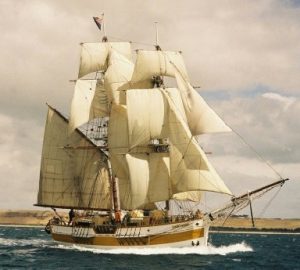
The Lady Nelson’s link to the area of Port Phillip Bay commenced in November 1801. On her second voyage south from Port Jackson, under the command of Lt. Murray, the Lady Nelson was required to again survey the coast to the south and to fill in a number of gaps in maps of the Australian cost at that time.
Land was sighted on 19 November that turned out to be Flinders Island, in the Furneaux Group, off the north-west tip of Tasmania, and not the Kent Group as intended. Lady Nelson anchored between Store House and Cat Islands in the Babel group of islands, off the east coast of Flinders Island, and remained there until 24 November.
From the Furneaux Group, Lady Nelson headed for the Kent Group and anchored in West Cove on the eastern side of Erith Island. Lady Nelson remained in West Cove until 4 December during which time the channel, now known as Murray Pass, was comprehensively surveyed using her boats.
From the Kent Group Lady Nelson headed north-west, passing Wilson’s Promontory and Cape Liptrap and anchoring in Western Port on 7 December. Bad weather detained Lady Nelson in Western Port for several days, during which time she had to re-anchor several times.
A light easterly wind enabled Lady Nelson to leave the anchorage in Western Port on 4 January. After stopping in Elizabeth’s Cove to replenish water casks, she followed the coast to the west. The next day they saw a headland bearing west-north-west, distant about 12 miles and an opening in the land that had the appearance of a harbour north-west 10 or 12 miles.
Lady Nelson sailed to within 1½ miles of the entrance and from the masthead Murray observed a sheet of smooth water and he recorded ‘it is apparently a fine harbour of large extent’. Murray did not attempt to approach any closer to the harbour because of a fresh on-shore wind. Not being able to enter, the as yet unnamed Port Phillip, Murray continued west towards Cape Otway but was unable to make any further progress westwards due to a south-westerly gale and headed for calmer waters to the eastern side of King Island.
The Lady Nelson departed King Island on 24 January and sailed north heading for Cape Otway, however bad weather again intervened and she turned east following the coast sighting both Cape Shanks (Schanks) and Grant’s Point before returning to Western Port. On 31 January 1802 Lt Murray sent a launch with six men and provisions for 14 days provisions and water to examine the entrance to the large bay sighted earlier in their voyage. The launch returned 4 days later reporting that they had found a channel that would provide safe entry into the bay. On the 14 February 1802 the Lady Nelson left Western Port and by noon that day the ‘new’ harbour was entered and was named by Murray as Port King, however Governor King renamed it Port Phillip after the first Governor of the colony Capt. Arthur Phillip.
Research: Graeme Reilly (Altona Laverton Historical Society)
In 1987, the Werribee Council undertook the redevelopment of a section of Altona Meadows located south of Central Avenue and east of the Bruce Comben Reserve, extending through to Merton Street. The streets in this area renamed in recognition of the contributions made by former and current residents of Laverton to their community. Seventeen residents were chosen for their role as Officers in Charge of the RAAF Bases at Point Cook and Laverton. One of these was Air Vice-Marshal John Fullarton (‘Ginty’) Lush.
John Fullarton Lush was born on 17 September 1915 at Hawthorn, Victoria, to parents John Fullarton Lush snr and Dora Louise Emma Lush (nee Puttmann). John attended Camberwell Grammar, Carey Grammar and then attended the University of Melbourne. John enlisted as an Air Cadet on 17th January 1938, and he was appointed to a commission in the General Duties Branch on 17th December 1938 with the rank of Pilot Officer after having successfully completed a flying training course at Point Cook. During World War 2 he saw active service in the United Kingdom, from 23rd September 1940, with 10 Squadron to 4th June 1942. He returned to Australia, where he then served in Darwin and the Southwest Pacific area. Before he returned to Australia, John married Avice Dehane Anderson on 9 September 1941 at Burnham-on-Sea, Somerset.
On 21 June 1950 he served with 38 Transport Squadron in Malaya and with 90 Composite Wing. The advance party from 38 Squadron arrived at the RAF base, Changi, Singapore, on 19 June. The squadron was operational ten days later, although it did not receive its full strength and equipment until 6 July. The squadron’s first involvement in the Emergency occurred on 12 July, when one of its Douglas C-47 Dakota’s undertook a five-and-three-quarter-hour air ambulance flight to Kuala Lumpur and jungle airstrips at Ipoh and Taiping, to evacuate wounded Singaporean soldiers.
On 23 July, the squadron dropped supplies to troops on the ground near Kuala Lumpur, and on 3 August two of the squadron’s Dakotas, with other RAF aircraft, dropped 103,000 propaganda leaflets over communist-controlled territory. These leaflets called on the terrorists to surrender. Six days later a Dakota participated in a bombing raid on an area near Kota Bharu, flying over the target area, checking on weather conditions, and marking the target with smoke for bombers.
As the squadron was part of the Far Eastern Air Force, its duties in the Malayan Emergency ranged widely. The squadron’s time was spent flying transport courier services to Ceylon, Borneo, the Philippines, Indochina, Hong Kong, and Japan. However, in July Australia committed ground troops to the war in Korea, at which time the squadron came under increased pressure to meet the growing transport needs demanded by the war. In November four of the squadron’s Dakotas, including supporting crew, transferred to Korea and became 30 Communication Flight. On his return he served various postings within Australia and by 1st July 1955 he was promoted to the rank of Group Captain.
In 1963, John Lush served as the Australian Air Attaché to the Australian Embassy in Washington and following this appointment, was posted to be Director of Air Force Plans at the Department of Air in Canberra. In 1967 he served as the RAAF Commander, Vietnam, during that conflict, serving there for approximately twelve months. It was for his service here that he was awarded the Order of the British Empire, Military Division on 4 February 1969. His citation read:
“Air Commodore John Fullarton Lush, OBE, assumed duty as Commander Royal Australian Air Force, Vietnam, as Deputy Commander Australian Force, Vietnam, on 16th May 1967. He fulfilled both of these appointments with considerable distinction until returning to Australia on 29th March 1968. Air Commodore Lush, by his vigorous leadership, wealth of experience and Spirit of co-operation, made a significant contribution to the smooth integration and co-operation of RAAF Units with other Australian and Free World Forces in Vietnam. Under his guidance RAAF Units achieved a high level of competence which enabled the units to achieve results far in excess of what would normally be expected. The efficiency, aggressiveness and professional skill with which Air Commodore Lush executed his duties earned for him the highest respect of the Commanders of the Free World Forces and reflected great credit upon himself and the Royal Australian Air Force.”
On 1 May 1968, Air Commodore John Lush was appointed the officer in charge of the RAAF Base Point Cook and as Commandant of the RAAF Academy. Air Vice-Marshall John Fullarton Lush retired from the RAAF effective 17 December 1970. During his time in the service, he was awarded 1939-45 Star, Atlantic Star, Africa Star, Pacific Star, Defence Medal, War Medal 1939-45, Australian Service Medal, General Service Medal with clasp ‘Malay’, 1953 Coronation Medal, Vietnam Medal, Republic of Vietnam Medal and the Australian Active Service Medal 1945-74. John Lush passed away on 3 December 1977 in Mornington, Victoria.
.
 In 1987, the Werribee Council undertook the redevelopment of a section of Altona Meadows located south of Central Avenue and east of the Bruce Comben Reserve, extending through to Merton Street. Some of the streets in this area were renamed in recognition of the contributions made by former and current residents of Laverton to their community. Seventeen residents were chosen for their role as Officers in Charge of the RAAF Bases at Point Cook and Laverton. One of those honoured was Air Commodore John Robert MacNeil.
John Robert MacNeil was born in Parkville, Melbourne on 12 November 1927, he was the son of William (Bill) Frederick MacNeil[1], a merchant navy officer, and Josephine Elizabeth MacNeil (nee Cullen), a seamstress. John grew up during the Depression and WWII in Pascoe Vale South, which back then was predominantly paddocks. John joined the Air Training Corps and in 1945 was accepted for RAAF pilot training, only to have his ambitions halted by the ending of the war a few months before he turned eighteen.
John completed his engineering studies and then decided to attend teachers’ college and then spent a few years as a schoolteacher in various Victorian country schools. With the outbreak of the Korean War, John decided to join the army, but his father convinced him to join the air force instead because he could reach Sergeant sooner! So, John enlisted in the RAAF and joined No. 7 Aircrew Course on 26 February 1951 at No. 1 Flying Training School, RAAF Base Point Cook. Towards the end of the course John elected to undergo training as a navigator and transferred to RAAF Base East Sale to commence No. 7 Navigator Course. On graduation in August 1952 John gained promotion to the rank of Sergeant and posted to 86 Transport Wing at RAAF Richmond.
John was then sent to 91 Wing based in Japan and Korea at the end of February 1953 and served there for the next nine months as a Dakota (C-47) navigator with 30 Transport Unit based at Iwakuni and Kimpo. Here John flew 765 hours on operations and participated in the repatriation of prisoners of war under Operations Little Switch and Big Switch in the period April to November 1953.
In 1954 John was seconded to 817 Squadron Royal Australian Navy as an observer aboard HMAS Sydney, which gave him an opportunity to gain insight into Navy life, before he returned to 11 Squadron. Following this assignment, John undertook an Advanced Navigation Course and then transferred to the RAAF College in 1956 as an instructor. Following this, John MacNeil was the Aide-de-camp to Governor-General, Field Marshal Sir William Slim, during which time he met his future wife Joan Mullins, an Ansett air hostess, and they married in April 1957.
In 1958 John was off overseas as an exchange officer to the UK with 50 Squadron Royal Air Force and later 35 Squadron Royal Air Force on Canberra bombers. In 1964 John attended RAAF Staff College and then became the personal staff officer to the Minister for Air, Peter Howson until the end of 1966. He was then posted on exchange to the United States as a flight commander with the 3536th Navigator Training Squadron in Sacramento for two years.
From 1969-1971 John was the CO of the Officer Training School at Point Cook following promotion to Wing Commander. In 1972 John was back in Canberra initially working in the Equipment Requirements Staff. He attended the Joint Services Staff College in 1974 and then spent time in Air Force Plans, before proceeding to Maylasia as the Defence Attache with a promotion to Group Captain. From 1978 to 1980 John was the Officer Commanding RAAF Base Laverton – the first navigator to hold the position. In 1980 he gained promotion to Air Commodore and took up the position of Director General Service Conditions, from which he retired in March 1982 after 31 years of service.
John MacNeil continued working for many years after retirement from the RAAF, including as Assistant Administrator of the National Trust (Victoria), as a high school teacher, and as an instructor at the Defence International Training Centre at Laverton. He was an avid gardener, and in his late eighties started a tree farm outside Bendigo. He later moved to Frankston where he passed away quietly on 19 March 2020.
[1] William spelled his name as MacNeil, whilst Josephine and then John used Macneil.
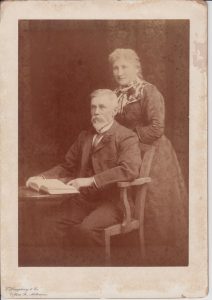
George and Alice Missen
Missen Court is named after pioneer settlers to the area George and Alice Missen and their family. George Missen, had been a colonist of 63 years, was very well known across the districts of Altona, Werribee and Rockbank. He was by turns a publican, farmer, businessman and local politician. He had owned the Rose and Crown Hotel at Rockbank and was also associated with the Metropole in Bourke-street, Melbourne, and the Point Hotel in Dynon’s Road.
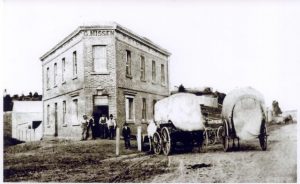
Point Hotel owned by George Missen
He was engaged in farming pursuits at Rockbank and Melton and owned a considerable amount of land at Altona. George Missen was a farmer and former shire councillor (1893 to 1899) of Wyndham, which was re-named Werribee in 1909. He had bought land and settled on the Altona estate in the 1890s, bringing his dwelling with him and re-erecting it on the corner of Queen and Sargood Streets. In conjunction with Alice and his eldest son William John, George combined farming with a district butchering business. Alice Missen was usually listed in rate books as the occupying tenant of the beachfront farm at Altona to the west of Fanny Street (renamed Rayner Street). It was for this farm that George Missen in 1899 obtained a shire permit to boil down fat, which suggests that animal slaughtering was being done.
George Missen not only brought his family and business to Altona he utilised his knowledge and experience serving in local council. On the evening of 20 March 1915 between thirty and forty of them responded to a call to meet at George Missen’s house. They formed a local action committee to press for renewing the railway, for a government road extending west from Nellie Street to meet the road to the powder magazine (now Maidstone Street), and for the establishment of a school, either full or part-time. He believed that on some matters a combined approach was needed, and thereby the seeds of community were sown.
Mr. George Missen died in Nurse O’Neill’s private hospital on Wednesday as a direct result of an accident sustained at Rockbank some weeks ago. As was previously reported in these columns, Mr. Missen fell whilst getting into a sulky and broke his leg. He was 83 years of age, and the injury refused to mend. Mortification set in, and he died rather suddenly in February 1921.
Research: Graeme Reilly (ALHS) 2020
In 1987, the Werribee Council undertook the redevelopment of a section of Altona Meadows located south of Central Avenue and east of the Bruce Comben Reserve, extending through to Merton Street. The streets in this area renamed in recognition of the contributions made by former and current residents of Laverton to their community. Seventeen residents were chosen for their role as Officers in Charge of the RAAF Bases at Point Cook and Laverton. One of these was Air Marshal John William ‘Jake’ Newham.
John William Newham was born, in Cowra New South Wales, on 30 November 1930 and was educated at the Cowra High School. After completing year twelve, John worked as a clerk with the Commonwealth Bank. At the age of twenty, John was faced with his first tough life decision, having been offered a place at both Duntroon and in the Air Force’s pilot training program, he needed to decide on a career in the Army or Air Force, and it was the latter that won out. It was perhaps an example of the imminent good sense for which Air Marshal Newham was to be later renown for.
The first impact John Newham made was in the skies over wartime Korea in 1953 with the No. 77 Squadron flying Gloster Meteor jets. From 13 March 1953 until the end of the war he flew and fought with great distinction. Having now been commissioned as a pilot officer, midway through his Korean service, John Newham’s next posting was with No. 78 (Fighter) Wing on Malta, where he flew de Havilland Vampires until 1955. John Newham was one of five Korean War veterans who replaced pilots posted back to Australia. John was later to state that his time in Korea shaped the leadership and command approach he took later in his career.
When John returned to Australia, he married Thelma Joyce ‘Jo’ Cranston, in 1956, and they had three children, two daughters and a son together. It wasn’t long before John Newham had been promoted to flight lieutenant and he had begun training on the recently introduced RAAF CAC Sabre jet, sometimes known as the Avon Sabre or CA-27. As was the life of Air Force personnel and their families, from 1958 to 1960, John Newham served in Malaya with the No. 3 Squadron, whose Sabre jets conducted operations against communist guerrillas in the final years of the Malayan Emergency[1].
Back in Australia, John Newham attended RAAF Staff College in Canberra from January to December 1964. He then served as Chief Flying Instructor at No. 2 Operational Conversion Unit at RAAF Base Williamtown, New South Wales, taking temporary command of the unit as a squadron leader from July 1965 to April 1966. August 1966, saw him commence conversion training on the Dassault Mirage III supersonic jetfighter. Then, promoted to wing commander, from July 1967 to October 1968 he led the No. 3 Squadron at Williamtown as it re-equipped with the Mirage jet. In 1972, John Newham was appointed as the Officer Commanding RAAF Base Laverton, Victoria.
By now promoted to group captain, John Newham was appointed Officer Commanding No. 82 Wing at RAAF Base Amberley, Queensland, in 1973. He then formed the RAAF Washington Flying Unit at McClellan Air Force Base, California, and on 31 March ferried the first twelve General Dynamics F-111C swing-wing bombers to Australia. On 1 June 1973, John Newham led the first three F-111s to land at Amberley, a gala occasion attended by the Deputy Prime Minister and Minister for Defence, the Chief of the Air Staff, the Air Officer Commanding Operational Command and a large media contingent.
Through the years 1975 and 1976 as the senior operations officer at Operational Command, Air Marshal Newham managed the air evacuation of Darwin after Cyclone Tracy, the deployment of Air Force on UN peacekeeping missions as well as the evacuation of Australians from Saigon during the fall of South Vietnam. Air Marshall Newham himself was always quick to point out that the success of these operations was due to incredibly good AirForce people in the squadrons. Typical of his humility, he did not seek recognition for his own important contributions to these incredibly consequential operations.
Many in the Air Force could see Air Marshal Newham’s qualities though. He was sent to the Royal College of Defence Studies in the United Kingdom and later served with great distinction as the Defence attaché in the US. On his return to Australia in 1984 he was appointed as the Deputy Chief and in 1985 promoted to Air Marshal and appointed as the Chief of the Air Staff and retired from service in 1987. After retiring he was appointed a Director of HeliTech Industries, a helicopter logistics, maintenance and repair company. On 23 July 1998, he was among those present when the Korean Ambassador to Australia awarded his government’s Presidential Unit Citation to No. 77 Squadron. John William Newham was one of ten surviving veterans of the squadron belatedly presented with the United States Air Medal in Canberra on 27 June 2011, for meritorious service in the Korean War. In June 1984 he was awarded the Officer of the Order of Australia and then in June 1986, a Companion of the Order of Australia. He died on 27 December 2022 in New South Wales, at the age of 92, and was survived by his three children, Bronwyn, Murray and Kate.
[1] The Malayan Emergency, also known as the Anti–British National Liberation War, (1948–1960) was a guerrilla war fought in Malaya between communist pro-independence fighters of the Malayan National Liberation Army (MNLA) and the military forces of the Federation of Malaya and Commonwealth (British Empire). The communists fought to win independence for Malaya from the British Empire.
Everyday local Laverton and Altona Meadows residents driving home from the direction of Melbourne are likely to exit from the Princes Freeway at Newland Street, located a short distance after travelling over the Melbourne-Geelong railway. Commonly streets are named after residents who have made their mark early pioneers, landowners, councillors, or persons who have contributed, in some way, to the growth and prosperity of their community.
The Newland name appears in many of the early records, stories, and articles of the pioneers of Laverton. William Newland and his wife Louisa (nee Wall) arrived in Laverton in 1896, ten years after the first land sales in the area, with their nine children, and a further two children were born in Laverton in 1896 and 1900. Both William and Louisa had been employed by the Victorian Railways when the new rail link between Geelong and Camperdown was opened in 1883 and again, arriving at Laverton, they were both employed by the Railways. Louisa as a gatewoman/keeper, often a low paid job responsible for manually operating a level crossing gate. The role meant that the gatekeeper needed to be available to open gates in the middle of the night, if necessary, in any type of weather. The railway gates Laverton were at the old Geelong Road (today Forsyth Road) rail crossing. William was employed as a ganger, which meant that he and his team were responsible for inspecting and repairing specific lengths of track to ensure its safety. The gangers travelled along the track on ‘cars’ or ‘trolleys’ that were manually operated vehicles.
Over a period, they Newlands accumulated some eight blocks of land between 1896 and 1919 in the vicinity of High Street, five block, Merton Streets, two blocks and a single block in Jamison Street. Why so many? Well, it was not that they were developers or investors but to grow your own food, operate a small store, and raise livestock to sustain a growing family, you needed sufficient land. Many of their eleven children attended the Laverton State School which became the focal gathering and meeting place prior to and during World War 1.
William was very active in local affairs, he was named in the convening of a meeting to form a Company of Australian Light Horse in 1904 and as a member of the Laverton Progress Association was instrumental in the building of the new Memorial Hall (since replaced) Four of his sons served their country in the Great War, World War 1. William (Jnr) and James Ernest were the first of the brothers to enlist into the army, and both had previously served during the Boer War in South Africa. William (Jnr) returned wounded from Gallipoli to a grand welcome home and reception by the local community.
Herbert Leslie and Alfred Lindsay enlisted later, and both served in France, however in November 1916 Alfred was killed when a bomb exploded whilst he and his men were rotating men to and from the front line. Captain James Ernest, eventually to become Lieutenant Colonel, was awarded the ‘Victoria Cross’ in July 1917 for his gallant action across three separate occasions in April 1917, where he led his battalion to victory in the face of the enemy and he received his award from King George V at Buckingham Palace. James returned to Australia and continued to serve in the army until 1941, when he began working for the Australian Red Cross and then the Footscray Ammunition factory.
His brother, Herbert, returned to Australia on 23 October 1918, and on his return, he rejoined the Victorian Police Force and was Sergeant in charge in Queenscliff and Geelong police stations before moving to St Kilda where he took up position as Sergeant in charge of the first shrine guard at the new Melbourne Shrine of Remembrance. But it was not just the family’s four sons that were in the Newland’s thoughts, their daughter’s, Irene, beau, Albert Hyde, was also fighting in France.
Whilst her sons were overseas serving their country, Louisa rallied the local women to gather and make items to be sent to those on the front line and to raise funds for the Red Cross cause. This was not the only cause of local association that the Newland family assisted in. They were instrumental in and great supports of the founding of the Laverton football and cricket clubs.
In an unfortunate accident on the 13 December 1921, aged 62 years, William rode out on his horse from the homestead about 1pm to look for cattle that had strayed, Men working in a nearby field, describe what they saw in their witness statements “…I went to the man lying on the road he was not quite insensible but could not tell me his name and was apparently suffering from concussion after falling from a horse… “and “…I went to the horse, some distance away, and although the saddle and bridle were intact it appeared that the leather must have come away through a break in the stirrup iron, which I found further up the road, causing the fall.
William was transported to Dr. Hanley’s residence at Werribee and then on to a Melbourne Hospital. He unfortunately never regained consciousness and died on the 21 st December 1921 and was buried at Werribee. Louisa survived until 1947. Both are buried within the Werribee cemetery. Whilst the family members moved on to other towns and suburbs, the Newland name and their contribution to Laverton lives on.
Reserach: Graeme Reilly (ALHS 2026)
Having established the new colony of Port Phillip in 1835, John Batman returned to Launceston and chartered the barque Norval for £294 a month to transport supplies and livestock across Bass Strait. Norval Terrace, in Altona Meadows, owns its name to this vessel and its contribution to the new colony of Port Phillip, later to become Melbourne.
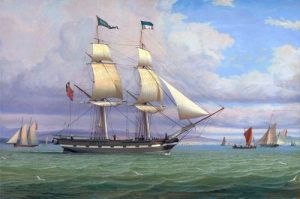 The Norval made the first of several voyages in November 1835. Her captain, Robson Coltish, recorded that Batman, who then accompanied her, planned all the fittings, pushed the work on quickly, and showed a perfect knowledge both of the Saltwater River and the Yarra Yarra River. Captain Coltish, of the barque Norval being about 300 tons, had brought to the mainland the first stock of the Port Phillip Association. “After taking on board”, says he, “five hundred sheep, and about fifty head of cattle, we sailed for Port Phillip. We had a quick passage across the Straits, about thirty hours. We entered Port Phillip Heads about eight or nine o’clock in the morning, and anchored at the mouth of the Eastern Channel. John Batman wished to go ashore at Indented Heads, to see some men he had left there on his last trip. While waiting for John Batman, we got the long boat out and had her rigged as a cutter, to go ahead of the ship, to sound the water depth. As soon as Batman returned, who brought with him a quantity of fresh vegetables his men had grown, we proceeded up the Eastern Channel under easy sail, the long boat going ahead and sounding. We got safely through the channel about dusk, and then shaped our course, by Flinders’ chart, for Hobson’s Bay, and anchored there at about two o’clock in the morning. At sunrise, we got the boats out, four in number, and loaded them with stores, tents, &c, and started for the Yarra. Mr Batman, passengers, and myself going ashore.”
When Batman reached the Yarra, he found his main camp on the north bank. During a brief visit, he landed extra hands, as well as livestock, and weatherboards fit for a house on Batman’s Hill, to which he brought his wife and seven daughters when he settled there in April 1836.
Bibliography
- http://adb.anu.edu.au/biography/batman-john-1752
- https://archive.org/stream/johnbatmanfound01bonwgoog/johnbatmanfound01bonwgoog_djvu.txt
- Traralgon Record 19 Mar 1915 pg 4
- John Batman, the founder of Victoria. James Bonwick
Research: Graeme Reilly (Altona Laverton Historical Society)
O’Brien Court, Altona Meadows was named to recognise the contribution of John Francis O’Brien to the progress and advancement of the Altona area. John was born in Footscray in 1890, and married Agnes Harrington in 1919. For some years he was employed in the Taxation branch of the Civil Service. Later he set up in business as a public accountant and taxation adviser working and living in Moonee Ponds. He was also the general president of the C.Y.M.S. and the brother of Reverend Fr. Peter O’Brien, the parish priest of St Teresa’s Essendon.
John and his family moved to Blyth Street, Altona around 1926 and quickly became involved within his new community. Adding to his profession as an accountant he purchased the picture theatre ‘The Strand’ situated on south east corner of Pier and Queen Streets which became the venue for a number of charity events and progress meetings. As a businessman of Altona, he was relied upon to advance the progress of the town. In 1928 when Altona was to be finally directly represented within the Werribee Council, John O’Brien was elected along with David Grieve and Charles Cherry. His profession as a public accountant and auditor has fitted him by training to have a full knowledge of financial matters, and his opinions were to be valued at the council level. Early in 1937 a committee was formed by Father Ken Morrison, St Mary Help of Christians, to purchase land for a new church site closer to Altona Railway Station. Two influential members of the committee were the Altona Riding Councillors, David Grieve and John O’Brien. The committee purchased land fronting Sargood Street and Railway Street North.
John O’Brien also served the fledgling Altona Community Hospital being one of the organising committee to get the hospital off the ground via a contributory and subscribers plan in 1932.
But in March 1937 a tragic car accident was to end the life of John O’Brien. Returning from a visit to his uncle’s, Rev. Fr. Joseph O’Brien the parish priest of Mortlake, the O’Briens were involved in a car accident near Colac in which John was killed. John O’Brien died leaving a wife and four children (Gerard, Mary, Margaret and Peter). He is buried within the Fawkner Memorial Park.
Research: Graeme Reilly (ALHS 2020)
Ocean Court was named after the Brig Ocean, an English merchant ship and whaler built in 1794 at South Shields, England. Her connection with this area was that she undertook a voyage where in 1803 she accompanied the HMS Calcutta to Port Phillip to establish a colony. These two vessels were to establish the settlement under the leadership of Lt. Col. David Collins. The Calcutta transported convicts, with the Ocean serving to transport supplies.
The British Government chartered Ocean from Messrs Hurry & Co as a supply ship and she carried 100 people along with supplies needed for the settlement at Port Phillip. The people on the Ocean included Captain John Mertho, nine officers, 26 seamen, eight civil officers including a surveyor, a mineralogist, and a group of free settlers. Many of the free settlers had skills that would be of value to the new settlement – five were carpenters, two seamen, two millers, a whitesmith (works with white or light coloured metals such as tin or pewter), a stonemason, gardener, painter, schoolteacher, pocketbook maker (maker of wallets and covered notebooks) and two servants.
The Ocean and Calcutta left Portsmouth on 27 April 1803 and reached Santa Cruz on the Island of Tenerife (Canary Island) on 17 May 1803. Both ships sailed from Tenerife on 21 May and arrived at Rio de Janeiro in Brazil on 29 June. While in Rio, Captain Woodriff of the Calcutta sent five marines under Lieutenant Sladden to help maintain order on the Ocean for the rest of the voyage. According to Reverend Robert Knopwood’s journals, ‘Mr. Hartley, a settler had behaved badly’ – and it seemed there was little love lost between some of the free settlers and Captain Mertho. They apparently regarded him as a tyrant, while he thought they were intractable. Both the Ocean and Calcutta left Rio on 19 July 1803.
The Ocean, the slower of the two ships, was directed to sail direct to Port Phillip if she lost contact with the Calcutta. The ships did lose contact so Ocean did not put in at Cape Town and sailed through the Southern Atlantic and into the Indian Ocean. She experienced frightening weather conditions for 77 days. Twenty days out of Rio, George Harris recorded that ‘for many days we could not sit at table but were obliges to hold fast by boxes and on the floor and all our crockery were almost broken to pieces, besides many seas into the cabin and living in the state of darkness from the cabin windows being stopped up by the deadlights … I was never so melancholy in my life before’.
The Ocean finally sighted land on 5 October she was on course and off Port Phillip. She arrived into Port Phillip on 7 October 5 days before the Calcutta.
While at Port Phillip, a number of convicts escaped. According to Rev. Robert Knopwood’s journal six convicts escaped from Sorrento on the evening of 27 December 1803. The settlement was in the process of closing down at the time, HMS Calcutta had already sailed for Port Jackson in New South Wales and the Ocean was preparing to sail for Van Diemen’s Land. The escaping convicts cut loose a boat from the Ocean and succeed in getting to shore where two were recaptured, one (Charles Shaw) was shot and seriously wounded. One escapee (Daniel McAllender) headed back to Sorrento and arrived in time to be taken on board the Ocean. One convict by the name of William Buckley decided to return to the beach alone and continued to follow the bay round to the opposite head in the hope of seeing and signalling to the Ocean, but by this time it had left. Buckley lived with the aborigines in the area for 32 years and was next seen in 1835. Buckley’s improbable survival is believed by many Australians to be the source of the vernacular phrase “Buckley’s chance” (or simply Buckley’s), which means “no chance”, or “it’s as good as impossible”.
When this settlement was abandoned, the Ocean, in two journeys, relocated the settlers, convicts (from the Calcutta) and marines to the River Derwent, Hobart Town in 1804.
Research: Graeme Reilly (Altona Laverton Historical Society)
Patton Court in Altona Meadows was named in recognition of one of Altona’s oldest and earliest residents and the head of what was likely the largest family in the Shire, Alice Elizabeth Patton. Alice was a well-known and highly regarded resident who had lived in Altona with her family since 1918. Her keen interest outside of her extended family was the Altona football team of which, since 1966, she is the only female life member. More information on the Patton family can be located at https://alhs.com.au/local-history/pioneer-graves/walter-patton/
In 1987, the Werribee Council undertook the redevelopment of a section of Altona Meadows located south of Central Avenue and east of the Bruce Comben Reserve, extending through to Merton Street. The streets in this area renamed in recognition of the contributions made by former and current residents of Laverton to their community. Seventeen residents were chosen for their role as Officers in Charge of the RAAF Bases at Point Cook and Laverton. One of these was Henry Aloysius Petre, the first commanding officer of the Central Flying School at Point Cook and is generally acknowledged to be the founder of the Australian Flying Corps (AFC).
Henry Aloysius Petre was born on 12 June 1884 at Ingatestone, Essex, England, son of Sebastian Henry Petre, solicitor, and his wife Catharine Elise Wilhelmina (nee Sibeth). Educated at Mount St Mary’s College, Chesterfield, he was admitted as a solicitor in 1905 but became interested in aviation and in 1910 taught himself to fly at Brooklands. In 1911 the Australian government had decided to form an Australian Flying Corps and advertised in England for two ‘mechanist aviators’. Petre successfully applied and was commissioned as an honorary lieutenant, Aviation Instructional Staff, Australian Military Forces, on 6 August 1912.
Arriving in January 1913, he was appointed the first commanding officer of the Central Flying School and is thus generally acknowledged to be the founder of the Australian Flying Corps, forerunner of the Royal Australian Air Force. He selected Point Cook in Victoria as the preferred location and had the school ready to accept the first course on 17 August 1914, just two weeks after World War 1 began. A request from the Indian Government for support in Mesopotamia, Henry Petre became Commander of the Mesopotamian Half-Flight (at Basra in what is now Iraq) from April 1915, and later No. 30 Squadron, British Royal Flying Corps (RFC).
The unit carried out several successful operations during November and December 1915 but living and working conditions were appalling and recently arrived aircraft were rejects from the Western Front. There was a serious lack of spare parts and spare engines. The operations were hazardous and resulted in heavy casualties. By 21 November only one aircraft and one pilot (Petre) remained, although reinforcements of men and machines soon began to arrive.
The squadron continued to be heavily and continuously engaged throughout 1916, with Henry Petre continuing in command until December when the unit was disbanded. Henry was posted to Egypt and promoted major on 16 December. By this time, he had been awarded the Military
Cross and the Distinguished Service Order and mentioned in dispatches three times (all in 1916). In February 1917 he was attached to No.15 Squadron, RFC, in France to obtain experience there before being posted to command No.29 Training Squadron, AFC, in England on 1 August.
Henry Petre resigned from the AFC on 31 January 1918 on being commissioned in the RFC and became a major in the Royal Air Force on its formation in April 1918 when he formed and commanded No.75 Squadron. He remained with the Royal Air Force until 15 September 1919; he then resumed his previous qualification as a solicitor with the legal practice of Blount, Petre & Co., solicitors, London, retiring in 1958. In 1929 he had married Kathleen Coad Defries of Toronto, Canada. Survived by her, he died in London on 24 April 1962.
Research: Graeme Reilly (2025)
Piri Grove was named to recognise the connection of the schooner Piri with the Truginina Explosive Reserve.
Built in 1917 at Balmain, New South Wales, by Morrison & Sinclair Limited, the Piri, prior to being conditioned for the purpose of carrying explosives, was the motor ship Tangaroa.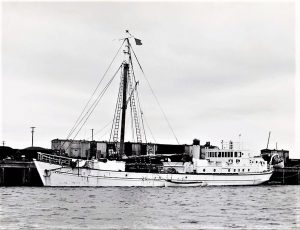
The schooner brought explosives from the Truganina Explosive Reserve for the Mines in the 1950’s to Greymouth and Westport. The Piri was originally a Topsail Schooner with two masts. The demand for more speed forced the sailing shipowners to equip their vessels with modern marine engines so they can maintain a good average speed under all conditions. As a number of her trips were in Bass Strait, lying right in the “roaring forties”, power was a necessity as the Strait has the reputation of the worst sea in Australia.
All precautions are taken on board the Piri to safeguard against the natural danger of her cargo. Members of the crew, who are specially selected, wear rope-soled shoes while working in the hold to prevent the possibility of causing sparks through bootnails striking against other metal. The schooner is wood lined throughout.
Like other ships the Piri had her share of mishaps. In February 1929 while sailing down Port Phillip Bay to the Heads, she appears to strike a submerged object which damaged her crank shaft and propeller forcing her to return to Melbourne. At the time, the Piri was owned by Nobels Pty. Ltd., was sailing for Greymouth New Zealand having discharged her cargo of explosives at the Altona powder anchorage. In March 1929 whilst on her way to New Zealand from Melbourne she lost the function of her rudder. Being about 10 miles off Sydney Heads she signalled for assistance and was towed into harbour for repairs.
It appears that the Piri remained in New Zealand, after this voyage, to ply the New Zealand waters as a cargo vessel. However, after an absence of nearly seven years the Piri, one of Australia’s biggest and fastest trading schooners was recommissioned by the Nobel company to join the Huia in the transportation of explosives from Australia to New Zealand.
It appears that on her final voyage on route from Melbourne, she lost her rudder 400 miles off Cape Reinga and eventually reached Auckland under a jury rig. There she stayed until she was laid up in Auckland towards the end of 1957.
Powlett Street, Laverton[i] was named by the original land development company or surveyors of Charles Raymond Staples and John Henry Wise in 1886. This was just prior to the first land sales within this area. Why this name was chosen by the developers is not known, but what we do know is who the person is that the street is named after, Frederick Armand Powlett. Was Powlett chosen for his influence within early Victoria legislature, or because he was a close acquaintance of Alfred Langhorne or was it that alphabetically, the developer needed a name stating with ‘P’ and his was first to come to mind.
Frederick Armand Powlett had left England with Sir John Franklin to Van Diemen’s Land in 1837 but quickly moved across to the Port Phillip District. Frederick did not see a life within the church as a vocation for him but saw opportunities within the fledgling colonies as where he should chance his luck there. Frederick’s father had been the chaplain to the Prince Regent, later to become George IV and was descended from the last Duke of Bolton. In November 1838 Powlett facilitated the formation of the Melbourne Cricket Club and three years later became its founding president. On the cricket field he is reputed to have taken the first hat trick in a cricket match in Victoria.
Frederick Powlett was a pioneer of the open plains around the Bacchus Marsh area and the upper reaches of the Werribee River, and for many years he held a large pastoral interest in the Mount Macedon, Pentland Hills and Pyalong regions, north of Melbourne. His plan was always to make his fortune, then return home, and he did not initially like Australia, describing it as ‘these detestable Colonies’, but he did see it as the land of opportunity.
In 1840 Frederick was appointed to the role of commissioner for the Westernport district and was still there when gold was discovered. He became the first gold commissioner in Victoria, with his precinct including Anderson’s Creek, Ballarat and Castlemaine, but he soon relinquished the post. In October 1852, after the death of Alastair MacKenzie, Frederick Powlett was temporarily appointed as the colonial treasurer, with a seat in the Executive Council, holding office until John Foster arrived from England in July 1853, to take up the role.
On 23 April 1851 Frederick Powlett had married Margaret, daughter of Dr William Thomson and a sister of John Campbell Thomson, who was the police magistrate at Gisborne. She died in 1853 at Laverton Estate, and their only child, a daughter Horatia Frances Janet Powlett, was sent to England. There she completed her education and eventually married her cousin, Armand Temple Powlett, a captain in the Royal Navy.
Frederick and Margaret had, a short time prior, leased Alfred Langhorne’s Laverton Homestead, as Alfred and Sarah were returning to England to school their two children. Frederick was acquainted with Alfred through their membership of the Melbourne Club and their keen interest in breeding thoroughbred horses. Upon the death of his wife, Frederick sought to end the lease agreement, forcing Alfred to seek another party to lease Laverton Estate during his absence.
Frederick Powlett was then appointed as the chief commissioner of crown lands, but when this role was abolished, he found himself without employment. He did receive compensation from the from the government for the loss of his office but was quickly appointed to the role of warden when gold was discovered at Landsborough, which sits between the towns of Maryborough and Stawell, in the western district of Victoria. In 1863 he was transferred to Kyneton as the police magistrate, an office he held until his death in 1865 at the age of fifty-four.
During his time in Port Phillip District/Victoria, Frederick held considerable influence over the progress of the colony and legal rule. He was called upon to make decisions in numerous squatting disputes, and his decisions were remarked as being both fair and impartial. Frederick Powlett was buried beside his wife, Margaret, within the Heidelberg (Warringal)cemetery.
[i] The reference to Laverton is related to the original subdivision of land that incorporates Powlett Street. This area is now known as Altona Meadows.
Ralph Court was named to acknowledge the contribution to the community of Altona by Albert (Bert) John Ralph. Bert Ralph was born in 1905 in Redfern, Sydney,
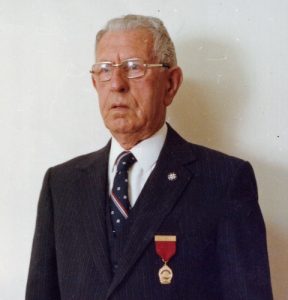
Albert (Bert) John Ralph
New South Wales to parents Albert John Ralph and Mary Ann Gertrude Ralph nee Frost.
Bert married Hannah Louise Beeden (1910-1960) in 1939 just at the outbreak of WWII in which Bert served from 1939 until the end of 1943 in the 2nd AIF obtaining the rank of Sergeant. Following the war, the family moved to Altona where they initially settled into a house in Nellie Street (Civic Parade) and Bert continued working as a carpenter. It wasn’t long before Bert began to get involved in various community activities. The family were active members of St Mary’s parish, but their support did not stop there. In 1947 Bert started the Boy Cadets of the St. John Ambulance Brigade in Altona, a society that he would go on to support throughout his life. After the loss of his wife Hannah in 1960 he remarried a few years later to Ruby and they both volunteered their time to a number of local organisations.
When he retired, Bert gave support to the Altona Senior Citizens and also the Altona Community Hospital. Bert served as the secretary and treasurer of the Seniors over different times and Ruby served as President for one term. Ruby also operated a trading table at the Senior’s clubrooms known as ‘Ruby’s shop’. They were both awarded life membership of the Seniors.
In 1977/78 Bert service to the Hospital was acknowledged when he was awarded Life Governor. In 1984 the Altona City council award Bert with their Citizenship Award in recognition of continuing and unstinted community service as an officer and member of St John Ambulance service commencing 1947, and of Altona Senior Citizens’ Club since 1970. He also received an award from St Johns Ambulance for his long service to the organization. Albert (Bert) John Ralph passed away in 1986 and is buried within the Altona Memorial Park.
Research: Graeme Reilly (ALHS 2020)
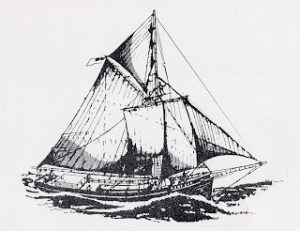 Rebecca Crescent is another street named after a 19th Century ship that sailed into Port Phillip to establish a new settlement. The 30-ton sloop Rebecca was launched in 1834, and was built by Captain George Plummer at his boatyard on the banks of the Tamar River at Rosevears, just north of Launceston, Van Diemens Land (Tasmania).
In 1835, owned by Robert Scott and chartered by John Batman, on behalf of the Port Phillip Association for his first voyage to Port Phillip. Sailing from Launceston, on the 10 May 1835, under the charge of Captain A. B. Harwood, he landed in Port Phillip Bay on 29 May 1835, where, later on 6 June 1835, John Batman entered into a treaty with the aboriginal people for use of their land and chose the site of the future city of Melbourne, known as the Batman Treaty.
After leaving a small party at Indented Heads, Batman returned to Launceston, on the Rebecca and announced his treaty to the colony at large. John Helder Wedge, who was also a member of the Port Phillip Association, then sailed to Port Phillip on the Rebecca to explore the country, landing at Indented Head and then sailing up the Yarra River, which he named.
It is believed that sometime later in October 1835, Samuel Anderson, a pioneer of Western Port, purchased the Rebecca for the use of the partnership of Anderson and Massie who operated from Bass in Victoria after Samuel Anderson established the third permanent settlement there in 1835.
The Rebecca had achieved fame as the vessel which had taken John Batman to Port Phillip in 1835 to establish the ‘village’ of Melbourne.
On 20 March 1839, in a gale at Cape Portland, Tasmania, the Rebecca ran aground. All hands landed safely and salvaged the cargo, but the vessel became a total wreck.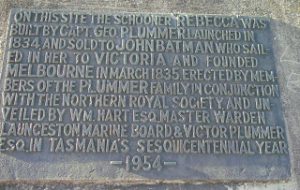
A memorial to the Rebecca was unveiled in 1954 near the site of George Plummer’s boatyard of the Tamar River at Rosevears, Tasmania, recording its role in the founding of Melbourne.
Research: Graeme Reilly (Altona Laverton Historical Society)
In 1987, the Werribee Council undertook the redevelopment of a section of Altona Meadows, located south of Central Avenue and east of the Bruce Comben Reserve, extending through to Merton Street. Several streets in this area were renamed in recognition of the contributions made by former and current residents, of the district, to their community, as nominated by their fellow community members. Reddrop Court was named to recognise the longstanding connection of the Reddrop family.
Charles Edward Reddrop and Edith Emily Reddrop (nee Merrett) had moved down to Werribee, from Shepparton, in 1904 just after the birth of their twin boys David and Ivan. Charles quickly opened a blacksmith and farrier business on the southeast corner of Duncans Road and Synnot Street. Charles and Edith had two more children, Mavis and then Eric. As the boys left school, they joined their father within the family business, which was one of five blacksmith businesses within Werribee, around the end of the first world war. Ivan and David were the first to join the business, however in 1923, at the early age of twenty-one, David passed away quite suddenly, which was quite a shock to both the family and the community of Werribee. It was reported that the funeral, for David, was one of the largest ever seen in the district over of one hundred friends attending the funeral service, such was the family’s prominence within the district.
Within a few years of his brother’s passing, Eric also joined the family business. The business had gained formidable reputation or fairness and reliability within Werribee and beyond, and outside of the business, the family were active members of the Werribee community. Ivan was the first of the Reddrop children to marry, when he wed Eva Walker at the Werribee Methodist church in 1926. Eva was the daughter of Robert and Helen Walker of Tarneit. Mavis married three years later and then Eric in 1938. Shortly after the family celebrated Eric’s wedding World War Two commenced and Ivan enlisted into the Army in 1942, at the age of forty. He joined the Australian Electrical and Mechanical Engineers Corps and was then posted to the camp in Ingleburn, New South Wales. At the completion of the war, he had served for three years and had gained both the rank of captain and an increased knowledge of being a motor mechanic, the later skill he brought back to the family business.
The family business continued until Charles passed away in 1955 at the age of eighty, while being treated at the Altona Hospital. With the business passing over to Ivan and Eric, thing began to change with a business focus the moved away from horses and across to motor vehicles. The site, on the corner of Duncans Road and Synnot Street converted to a Shell Service Station that also offered vehicle repairs and a transport business that offered daily pickups and deliveries between Werribee and Melbourne. This evolution of the business operated until the 1970s when both Ivan and Eric passed away ending a seventy plus year connection with the township of Werribee and the surrounding district.
Research: Graeme Reilly (ALHS 2026)
Alice Farrant with her sister Edith Roach
Roach Drive, Altona Meadows, runs East-West from Victoria Street to Edwards Drive and was developed and named around 1977/78. It is located in an area of Altona Meadows where several streets honour early residents of the Altona area and their contribution to its progress and history.
Roach Drive is no exception. It honours the contribution of Edith Ada Roach (nee Farrant) to the Altona community for over 29 years. She was awarded the City of Altona citizenship award in 1969 for her undoubted aid to the Altona Hospital where she served as the Honorary Secretary for 22 years as well as Secretary to the Altona Community Hospital Ladies Auxiliary and Honorary Treasurer of the Altona Red Cross.
Mrs Edith Roach (nee Farrant) was born in Essendon in on 28 February 1903, the third and youngest child of Albert George Farrant and Ada Mary Merrifield Farrant (nee Hargreaves). Edith lived with her parents in North Melbourne and, after leaving school, took on a position a as a typist.
In 1930, she married a young RAAF Engineer, Eric Athelston Glanville Roach, and they settled initially in Maidstone Street, Altona, before moving to Blyth Street.
In 1947, Edith Roach joined her sister, Alice Farrant, on the Board of the Altona Hospital, taking on the busy role of Hospital Secretary. This was a role she held until June 1969 when the required reporting and workload had increased to such an extent that a full-time manager needed to be appointed. Mrs Roach then continued serving on the board until June 1978. The hospital also awarded Edith a Life Governorship prior to her retirement.
Edith Roach was active in many sections of the community. Aside from her work with the local hospital, Edith Roach spent time as the secretary of the Altona Community Hospital Ladies Auxiliary prior to 1959. She was also Treasurer of the Altona Branch of the Red Cross until 1940 and was a member of the welfare committee of the Altona Elderly Citizens’ Club.
Eric and Edith were keen golfers, and it wasn’t long before they joined and entrenched themselves into the development and progress of the Williamstown Golf Club that later became the Kooringal Golf Club. Edith was Captain of the Associates (Ladies) in 1950 and 1951 and husband Eric was Men’s Captain in 1954 and 1955, Club Champion in 1952, Runner-up in 1953 and winner of the Laurie Parker trophy in 1949.
Edith Roach passed away on 2 March 1984 in Windsor, four years after the death of her husband Eric (September 1980), and were both cremated at the Springvale Botanical cemetery.
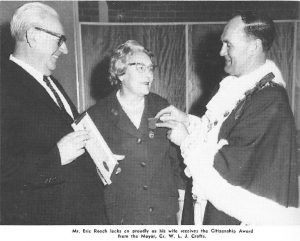
Edith Roach receiving her Citizenship Award, 1969
Research: Graeme Reilly, Editing: Michelle Yu
In 1987, the Werribee Council undertook the redevelopment of a section of Altona Meadows located south of Central Avenue and east of the Bruce Comben Reserve, extending through to Merton Street. Some of the streets in this area were renamed in recognition of the contributions made by former and current residents of Laverton to their community. Seventeen residents were chosen for their role as Officers in Charge of the RAAF Bases at Point Cook and Laverton. One of these was Group Captain Christopher Michael Vere Roff.
Christopher Michael Vere Roff was born in Launceston, Tasmania, in 1936 to parents Norman Hollingdale Roff and Katharine Isabel Roff (nee Hodge). At the time of Christopher’s birth, his father was the Headmaster of the Launceston Church Grammer School at the age of thirty-two, which Christopher and his younger brother Phillip, attended for their own education. At the age of four, Christopher’s father enlisted into the army, during World War 2, and was serving on Timor when he was ‘killed in action’ on 23 February 1942. Both Christopher and his brother continued studying at the school where their father served as Headmaster.
Christopher Roff joined the Royal Australian Air Force in 1954 and graduated from No. 15 Navigator Course at Point Cook in October 1957. He then served at the School of Air Navigation, Royal Australian Air Force base at East Sale where he attended and passed the No 16 Advanced Navigations Course in April 1961 (see image below).
Christopher Roff then served in both Royal Australian Air Force Maritime Squadrons No. 10 and No. 11 flying in Lincoln, Neptune, and Orion aircraft. In December 1962, in Adelaide, he married Lynley Warwick Barter, who was born and raised in South Australia and together the had three children, a daughter and two sons. The two met in Townsville, Queensland, where Lynley had been serving as a nursing sister on the staff of the General Hospital in Townsville and the then Flight Lieutenant Christopher Roff was stationed at the Royal Australian Air Force base at Townsville.
Christopher Roff then spent time overseas, on exchange in London, England, and with the Royal Canadian Air Force flying Argus patrol aircraft. On his return to Australia, he completed the Royal Australian Air Force Aero Systems Course and has graduated from the RAAF Staff College and the Australian Joint Services Staff College. He then served for three years in Washington, in the Australian USA Embassy. He followed this with several staff tours including as an Advisor to the Strategic and International Policy Division, Department of Defence. On 11 October 1979 Christopher Roff received the National Medal in recognition of his long and diligent service within the Royal Australian Air Force.
In July 1982, Group Captain Christopher Roff was appointed to the position of Officer Commanding the Royal Australian Air Force base Laverton where he served until December 1985. During his time at Laverton, he saw the opening of the Defence Cooperation Language School complex and the building a new Airmen’ s quarters and ensured the updating of some of the more antiquated regulations relating to Airmen and Airwomen. His next posting was to Canberra where he accepted the appointment of Director of the Office of the Chief of Air Staff.
In 1987, the Werribee Council undertook the redevelopment of a section of Altona Meadows located south of Central Avenue and east of the Bruce Comben Reserve, extending through to Merton Street. The streets in this area renamed in recognition of the contributions made by former and current residents of Laverton to their community. Seventeen residents were chosen for their role as Officers in Charge of the RAAF Bases at Point Cook and Laverton. One of these was Air Vice-Marshal Hans Jorg Friederich Roser.
Hans Jorg Friederich Roser, was born on 6 June 1937 and his early years spent in the Freiburg region of southwest Germany. Hans emigrated with his family to Australia in 1949, following the end of World War 2.
In January 1955, Hans Roser entered the Royal Australian Air Force College at Point Cook as a member of No 8 Course and graduated as a pilot in December 1958. His first posting was to No 23 Squadron at Amberley, Queensland and then to No 76 Squadron at Williamtown, New South Wales in 1960, flying Vampires. He completed No 5 Sabre Conversion at No 2 Operational Conversion Unit in 1961 and was a member of No 76 Squadron when it re- equipped with Sabres.
After a posting to the Department of Air in Canberra as a Personal Staff Officer, he transferred to No 78 Wing Butterworth, Malaysia in 1965, serving as a squadron pilot and later flight commander in No 3 Squadron. He completed four tours with No 79 Squadron in Ubon, Thailand. On return to Australia, he completed a Mirage Operational Conversion Unit (OCU) in 1968. In 1969, Hans undertook USAF F-4C training at Davis Monthan Air Force Base, Tucson, Arizona, before completing a tour of duty in South Vietnam at Cam Ranh Bay with the 12th Tactical Fighter Wing, flying Phantom aircraft on strike operations.
For his service with the United States Air Force, Hans Roser was awarded the Distinguished Flying Cross with Oak Leaf Cluster (US) and the Air Medal (US). On return to Australia and completion of No 25 Course, RAAF Staff College in 1971, he was promoted to wing commander and served at Headquarters Operational Command. In January 1974, he assumed command of No 75 Squadron at Butterworth after which he returned to Canberra, on promotion to group captain, as the Director of Air Force Plans.
Hans Roser was then appointed Officer Commanding RAAF Laverton in January 1979. Two years later was promoted to air commodore and posted as Director- General of the Tactical Fighter (Hornet) Program. He served as leader of that program until 1986, and it was said that Hans noted that this was his most satisfying posting. Hans Roser was awarded a Member of the Order of Australia, in the Queen’s Birthday 1986 Honours, for his leadership and performance.
On promotion to air vice-marshal, Hans Roser was appointed Commander Integrated Air Defence System in Butterworth before returning to Canberra as Assistant Chief of the Air Staff – Materiel. He was subsequently appointed Assistant Chief of Defence Force (Personnel) until his retirement in the early 1990s. Air Vice-Marshal Roser gained years of experience in the defence and aviation industry in Australia and overseas. His expertise lies in strategic planning, project management of high technology projects and executive representation with government. He has extensive overseas defence experience in Malaysia, Singapore, Thailand, Vietnam, the United Kingdom, and North America, where he served in his military career.
During his Air Force career, Hans was involved in several major Air Force acquisition projects, particularly the F/A-18 Hornet fighter aircraft, which had a project cost of some $4.5 billion. Later as Chief of Materiel in Air Force he was responsible for all Air Force acquisition programs.
Between 1990 and 1998 he worked as a senior executive with companies Kinhill Pty Ltd and Brown & Root Asia Pacific, where he held corporate responsibility for business development with the Federal Government and Defence. Between 1998 and 2002 he was a member of the board of Eurocopter International Pacific and from 2000 to 2003 he was Chief Executive Officer of Thales International Pacific Holdings. It was said that -to all who had the privilege of knowing Hans Roser, in both military and civilian life, he was a true gentleman and the epitome of a leader. They do not come any better.
Hans Jorg Friederich Roser died on 15 December 2020 and was 83 years of age and interred within the Norwood Park cemetery, Mitchell, ACT. Hans was survived by his wife Caryl Robin Roser and two children.
 In 1987, the Werribee Council undertook the redevelopment of a section of Altona Meadows located south of Central Avenue and east of the Bruce Comben Reserve, extending through to Merton Street. Some of the streets in this area were renamed in recognition of the contributions made by former and current residents of Laverton to their community. Seven of these residents were chosen for their role as Councillors of the East or Altona Riding of the Werribee Council. One of these is Skehan Boulevard named to honour the contribution of Councillor Kevin Barry Skehan.
Kevin Barry Skehan was born in Kilmore on 12 August 1933 to Barry Ambrose and Cecilia Emma Skehan (nee McLeod). Kevin’s father was the undertaker at Kilmore, and so Kevin grew up in the area being educated at Assumption College in the town. In 1953, he joined the Royal Australian Air Force where he served until 1974.
After leaving the RAAF Barry established a sports store and squash court which he operated until 1988. Kevin married Phyllis Mary Simpson at St Mary s Catholic Church in Preston in 1961. They had five children: Maree, Patricia, Barbara, Barry and Amy. Their 50th Wedding Anniversary was noted in the Laverton Parish Bulletin in 2011. Following the example set by his father and grandfather, Kevin became actively involved in community life. His grandfather, Patrick Skehan was a Shire Councillor in Kilmore for over 30 years. Kevin Skehan was elected to the Werribee council in 1976 and served until the council amalgamations in 1994. He served one term as the Mayor of Werribee and following the council amalgamations, that saw Laverton become part of Hobsons Bay, he served as a councillor, at Hobsons Bay, until he retired in 1999.
Kevin held positions as Chairman, Secretary and Treasurer of over 20 organisations including the Western Region Group Training Scheme and the Laverton Rotary Club. Kevin Skehan was awarded the Order of Australia Medal (General Division) in 1991 for his Service to the Community. Kevin Barry Shehan died on 7 December 2020 at the Werribee Mercy Hospital and was laid to rest at the Kilmore Catholic Cemetery, Kilmore. His wife, Phyliss passed away on 6 July 2021 and is buried alongside her husband.
In 1987, the Werribee Council undertook the redevelopment of an area of Altona Meadows located south of Central Avenue and east of the Bruce Comben Reserve, extending through to Merton Street. Several of the streets in this area were renamed in recognition of the contributions made by former and current residents of Laverton to their community. Seven residents were chosen for their role as a Councillor of the East or Altona Riding of the Werribee Council. One of these was named after councillor Stuart David Southwick.
Stuart Southwick was a seventh generation Australian from one of the first Jewish families to settle here, and a man who knew the importance of family, hard work and giving back to his community. Stuart, served on the Werribee Council for almost 30 years, and was affectionately known as ‘the caring councillor’. During this period of his life, he fought hard for the betterment of the Laverton, the instigation of the Around Laverton community newspaper, facilities for Laverton’s Little Athletics Club, amongst others, and was a strong supporter of the Laverton Community Centre.
He also served on the Laverton Community Chest, Laverton Secondary College Council, Youth Council of Victoria and TRY Youth and Community Services being just some that he found the time for, but there were many others involving his Council responsibility, including Laverton North Kindergarten, Laverton North Primary School, and the Laverton High School.
Whilst not residing in Laverton, Stuart and his family operated their two businesses, Wik Industries and Cedel, within the Laverton precinct. It was said that Stuart was passionate about his ward in Laverton and about Werribee and would stand up to any injustices in the community. He also worked hard and stood up strongly for the Werribee South farmers. He was larger than life, always smiling, always busy, and always involved.
Stuart served his community for many years with diligence, integrity, honesty and empathy. As a respected Laverton businessman, he was also known for his charitable works with children and seniors. In more later years he was well known in the area as he worked from his Charity Shop in Lohse Street, Laverton.
Stuart, along with Jack Knight, started the Around Laverton newspaper that operated from 1979 until 2017. To get the paper started he arranged for his secretary, Joan Jackson, to go and ask a person in each street if they would be willing to deliver the publication in their street. In 1995, he was recognised for his work and service to local government and the community by being awarded a Medal of the Order of Australia (OAM) in the Australia Day honours.
How Stuart found time for all his commitments amazed members of all local committees on which he served. He lost his wife beryl in 2010, and he began to slow done a little, if Stuart ever could. A stay in hospital pushed Stuart to give his voluntary work away. However, on 19 February 2017, aged 84, Stuart David Southwick passed away. It was the end of an era and a strong devotion of a businessman and councillor with his much-loved suburb of Laverton.
By: Graeme Reilly (ALHS 2026)
Tatman Drive, Altona Meadows, was built and named in 1976 as the area of Altona Meadows developed, due to increased housing need and a growing population. This street was named to recognise the connection to Altona by the Tatman family, early British migrants and pioneers to the area. The Tatman contribution can be attributed to the three members of the family that migrated to Australia, and Altona, in 1926 from Birmingham, England.
The family consisted of two brothers, Robert Charles and Eli Frederick, and their father, Frederick Tatman. Frederick’s wife had passed away in 1924. It is not certain whether this unexpected event prompted their move to Australia, but Frederick and his sons made the move and started a grocery business, we believe within Altona House on the corner of Railway Street South and Pier Street. Interestingly, the Tatman family must have become acquainted with the Chorley family during the passage across on the the migrant ship Ormuz on 20 March 1926. Both families moved to Altona, at the same time and shortly after both sons married Edith and Ivy Chorley.
Frederick’s grocery business operated until the mid 1930s when he sold up having decided to move back to England where he remarried and retired. However, his two sons, having married, decided to remain in Altona, with Robert joining Frank Chorley, his father-in-law, in his grocery, licensed business and post office, where he managed the postal/bank agency side of the business. Robert remained in the business and running the postal side of the business until the business was sold in 1947 upon Frank Chorley’s death, and the following year the death of Alice Daisy Chorley. A short time after, Robert and Edith moved to Albert Park where they purchased a similar grocery business from a Mr Bert Sands, in Victoria Avenue, which became their own.
Eli Frederick Tatman, who had married Ivy Chorley, enlisted into the Royal Australian Air Force (RAAF) in 1929, being based at Laverton as a mechanic. In 1931 he and Ivy married and they lived in Queen Street in Seaholme. Eli was still serving in the RAAF with the outbreak of World War 2 and following the end of this conflict he remained serving with the RAAF. He was predominantly based at the Laverton base so close to Ivy who was now living in Rose Street Altona. Having left the RAAF in 1947 with experience and qualifications as an aircraft mechanic, Eli took a change of direction, and he and Ivy moved to Burwood South where they took up farming. They remained here until the late 1960s when they looked to slow down and contemplate retirement. They moved the South Yarra (1970) and the finally to Baxter (1977) where the settled into retirement.
In 1987, the Werribee Council undertook the redevelopment of a section of Altona Meadows located south of Central Avenue and east of the Bruce Comben Reserve, extending through to Merton Street. The streets in this area were renamed in recognition of the contributions made by former and current residents of Laverton to their community. Seventeen residents were chosen for their role as Officers in Charge of the Royal Australian Air Force Bases at Point Cook and Laverton. One of these was Air Commodore Ernest William (Tony) Tonkin. Before we begin to discuss Ernest Tonkin’s contribution to the Royal Australian Air Force and Point Cook base, we need to deal with the spelling error.
We believe that this court was always intended to be named to recognise Ernest Tonkin’s role at the Point Cook base and our research with Wyndham Council identifies that it was their intent to name so, but somewhere within the naming process there was a misspelling, and it was officially named Tomkin and not Tonkin. It is not the only street that had been misspelt, but more about that later. So, who was Ernest (Tony) Tonkin?
Born on 12 August 1921, Footscray, Ernest William Tonkin was the third child, second son, born to Edward Thomas Allan Tonkin and Amy Louise Tonkin (nee Jenkin). A further son, Ralph, was born shortly after Ernest. In February 1933, Edward Thomas Tonkin passed away suddenly at the age of forty, leaving Amy to bring up their four children, the eldest, Amy Laura, now being only fifteen years of age and the youngest, Ralph, being about ten.
Ernest Tonkin spent his early years living and attending school and church within the Footscray area. After leaving school, Ernest started employment as a property clerk whilst his elder brother, Allan was working for the National Bank of Australasia, neither following in their father’s footsteps of working with the railways. When the second world war broke out, both Allen and Ernest wanted to do the ‘right’ thing, and when they were close to their twenty first birthday enlisted. Allen enlisted with the Royal Australian Air Force whilst Ernest initially enlisted with the Army in October 1941, but one year later transferred to the Royal Australian Air Force, and like his brother gained his qualifications as a fighter pilot.
Flying Officer Ernest Tonkin was stationed in Europe, while his brother, Flying Officer Allan Tonkin, served in the Middle East. Allan lost his life in action on 14 January 1943 in Tripoli, Libya. Ernest was told of his brother’s death which must have played on his mind given that they were both doing similar operations just in different theatres of the war.
On 18 March 1945 Ernest Tonkin took off with his squadron of twelve Spitfire SM233’s to attack a rail junction west of Gouda[1] which was under enemy occupation at this time. During the attack, the squadron came under heavy fire from medium and light anti-aircraft guns and having just pulled out of his bombing dive, Ernest knew that he had been hit, which was confirmed by another pilot who observed smoke streaming from his aircraft. Shortly after, Ernest advised that his engine had now stopped and he could not make it back to base and would need to force land his plane. Whilst Ernest quickly looked for a safe place to land, his fellow pilot stayed close by to observe his landing and escape. Whilst he did see Ernest land on top of a canal, which caused the aircraft to break up Ernest was not seen leaving his plane. Owing to a shortage of fuel, the second pilot was unable to remain any longer and headed for home to report his observations.
Ernest had trouble extricating himself from the cockpit which had begun to fill with water, but he eventually managed to free himself from the wreckage. Soon afterwards he was able to contact a member of the Dutch underground, Frits Gautier, who was the son of the burgomaster of Berkenwoude. The burgomaster, Marius Gautier, made the decision to hid Ernest for three days before he was able to hand Ernest Tonkin over to the ‘resistance of Lekkerkerk’. He was then assisted by a local truck driver who escorted Ernest to another member of the resistance where Ernest hid for six weeks until the arrival of the Allied Forces at the beginning of May 1945. On the 7 May he made himself known to the Canadian troops, now in Holland, who repatriated him back to his 453 Squadron on 16 May 1945, unaffected by his ordeal. Ernest served out the remainder of the war before he was repatriated back to Australia and his much-relieved family.
Within a year of being back in Footscray, Ernest Tonkin made the decision to re-enlist with the Royal Australian Air Force on permanent service. On 4 August 1951, at the All-Saints Church of England in East St Kilda, Ernest William Tonkin married Joan Marcia Algie, the daughter of Lieutenant Colonel William Matthew Algie and Susan Violet Algie. Joan had served in the Australian Women’s Army Corps during the second world war, and her father had served in the first world war, as had Ernest’s father. Ernest had little time to enjoy married life as he was soon involved within the Korean conflict, serving with the Royal Australian Air Force as part of the United Nations Command. His service within the Korean War earned Squadron Leader Ernest William Tonkin an Order of the British Empire (O.B.E.) award in September 1953 for ‘Outstanding operational service whilst Wing Weapons Officer’.
On 11 January 1961, 30 Squadron was reformed at Williamtown as a surface-to-Air Guided Weapons Squadron under the command of Wing Commander E. Tonkin and equipped with Bloodhound Missiles. On 20 October 1961, the Squadron became the 30 Surface-to-Air Missile Squadron and on 30 January 1962 the Bloodhound Mk I System was taken over by the Royal Australian Air Force. The Squadron formed an integral part of the Sydney /Newcastle/Wollongong Aar Defence System and, in co-operation with fighter aircraft of 81 Wing.
From 1972 to 1977, Air Commodore Ernest Tonkin was appointed as the Commandant of the Royal Australian Air Force Academy in Point Cook/Laverton. Here he took a great interest in the museum and donated much of his considerable personal collection of artefacts to the museum. Air Commodore Tonkin was instrumental in bringing heritage flying to Point Cook with the invitation for Bob Eastgate to fly his privately owned ex-Royal Australian Air Force Mustang A68-104, registered VH-BOB, at Royal Australian Air Force Museum events. Air Commodore Tonkin had flown the very same aircraft in Royal Australian Air Force service. Other significant aircraft at Point Cook in the 1960s and 1970s were a World War II era Messerschmitt Me 163 Komet rocket-powered fighter and a Messerschmitt Me 262 jet fighter, both later returned to the Australian War Memorial. The Royal Australian Air Force Museum hosted many flying days during the 1970s and 1980s that were immensely popular with the aviation-minded public. Air Commodore Ernest William (Tony) Tonkin retired from the Royal Australian Air Force in 1977 and soon after was awarded the National Medal for his service within the Royal Australian Air Force.
Wing Commander David Francis, also an active member of the National Trust, drafted a recommendation for heritage recognition of three buildings at Point Cook’s southern tarmac in 1975. They were the original 1914 hangar, the heavily extended 1914 workshop and the 1917 F.E.2b battleplane hangar. He did so in conjunction with the champion of Point Cook’s heritage, Air Commodore Ernest Tonkin.
Ernest and Joan first semi-retired to Wantirna before immersing themselves into full retirement in the small township of Monbulk. Joan Marcia Tonkin passed away on 9 April 1992 and Ernest William Tonkin on 12 March 1999. The naming of a street in Altona Meadows honours his service and dedication to duty for his country and to his efforts in developing and securing the museum at the Point Cook Air Base. It is such a pity that the spelling was a little astray.
[1] Gouda is a Dutch city south of Amsterdam in the province of South Holland. It’s known for its namesake cheese and seasonal cheese market, regularly held on the medieval Market square. In WW2 Gouda was a location of both resistance and hardship, marked by Allied bombings of its railway yard and the hiding of its stained-glass windows from the Nazis
Research: Graeme Reilly (ALHS 2025)
In 1987, the Werribee Council undertook the redevelopment of a section of Altona Meadows, located south of Central Avenue and east of the Bruce Comben Reserve, extending through to Merton Street. Several streets in this area were renamed in recognition of the contributions made by former and current residents of Laverton to their community, and original settlers of the Truganina and Tarneit area. Townsing Court is named after early settler and landowner Henry George Townsing and his family.
Henry was born in Gisborne in 1871 to parents Charles Walter Townsing and Madeline Townsing (nee Clark). Henry was the eldest of eight children born to the couple and his early life and education occurred within the Gisborne area. In February 1892, Henry married Sarah Rebecca Williams, and they settled in the Deer Park area where they had three children before moving to Tarneit, in 1902 and purchasing a 320-acre property on what was to become Dohertys Road. Henry built a homestead on this land by the following year for the family. A 1915 map of the locality shows a house east of a ford on course of Dry Creek, on the north side of Dohertys Road, near the intersection of Derrimut Road. It was whilst here that the couple had two more children, between 1902 and 1905.
George Townsing leased his Tarneit property in 1910 to George McWhinney, a local farmer and two years later sold the 320 acres grazing property with its dwelling to another farmer, James Robinson. By this time George Townsing, and his family had moved districts and were farming at Diggers Rest. George developed a keen interest in the progress of his new locality and in 1917 he put his name forward as a council candidate and was successfully elected to the Melton Shire council. In 1922 George was elected to serve as the Shire President, and he remained on council until the end of his term in 1926. Believing that his work was not done, and his knowledge was still required, Henry stood for election, to the Melton Shire council, in 1934 and was again successful. He again served as Shire President in 1936.
In 1940, due to failing health and having served for further six years, Henry decided to again call it a day and retire from council. Henry continued farming in Sunbury and in 1943 his wife, Sarah, passed away aged seventy-five. Three years later, Henry was remarried to Marguerite Veronica Cutis and the couple moved to the Melbourne suburb of Essendon. The couple remained there, in retirement, until Henry’s passing on 2 June 1960 aged eighty-nine. He was buried alongside his first wife, Sarah, at the Sunbury cemetery.
Research: Graeme Reilly (ALHS 2026)
In 1987, the Werribee Council undertook the redevelopment of a section of Altona Meadows located south of Central Avenue and east of the Bruce Comben Reserve, extending through to Merton Street. Several streets in this area were renamed in recognition of the contributions made by former and current residents of Laverton to their community. Seven residents were chosen for their role as being Councilors of East or Altona Riding of the Werribee Council. One of these was Oswald Verity.
Oswald Verity was born on 13 April 1899, in Altofts, Yorkshire England, to parents Harry Verity and Maria Verity (nee Sampson). Oswald was the youngest of three boys born to the couple in England. In the 1911 United Kingdom Census, Oswald and his family were living at nearby township of Normanton[1]. His father, Harry, was forty-three and was working as an underground roadman at the local colliery. Oswald’s older brothers were employed; Lindley, 15, was an apprentice engineer/fitter, and Reginald, 14, was an office clerk. Times must have been hard, in England at that time, for in early 1912, the family set sail from London aboard the ship SS Indrapura, that arrived in Melbourne on 14 November 1912.
The family decided to settle in the Werribee district and appeared on the 1914 electoral roll living at Duncans Road, Werribee, with Harry listed as a farmer. Sadly, Harry Verity died just two years later, on 14 January 1916, aged forty-eight. At this time, the Great War was in progress and his son, Lindley Verity, just a few months shy of his 20th birthday had volunteered to join the army (28 April 1915). It appears that family members left their former occupations and now joined forces to work the family farm. In those times, a large majority of the farms, in this area, were engaged in lucerne and dairy farming. Oswald Verity was too young to enlist and with their father passing away, he and Reginald remained at home to assist their mother in working the farm.
We are aware that when Lindley returned from the war, he sought land, in the area, under the soldier resettlement scheme. He leased thirty-one acres on Duncans Road, Werribee, with the intent of growing lucerne and raising dairy cattle. It is not known whether Reginald or Oswald also purchased additional land, but a map of the Parish of Deutgam, dated 1951, shows Reginald occupying forty-seven acres on Duncans Road that run west to O’Connors Road, whilst Oswald occupied a property of forty-nine acres on the west side of O’Connors Road, adjacent to Reginald’s property. It may have been that Reginald had taken over his parents’ original property. Oswald’s property transferred from crops and dairy farming to market gardening, during the 1920s, which was more labour intensive and required the employing of additional workers.
Oswald Verity married Hazel Isabel Blake on 13 April 1930 at the local Werribee Presbyterian church and the couple settled down to farming life in Werribee South, and they eventually had three children, a daughter and two sons. It is not known how involved Oswald was in local affairs but as his children got older, he saw that the area of Werribee South needed better facilities for both families and their properties, and as a result his interest in local affairs developed. He was by now a member of the District Water Advisory Board, the Progress Association and sat on the committee of the Diggers Road School.
In 1945 Oswald nominated for a place on the Werribee Council representing the people of the East Riding. This was quite a large area that covered Werribee South, Laverton, Tarneit, and Truganina. His election campaign was successful, and he served as a Werribee councillor until he retired at the end of his second term in 1952.
Prior to his retirement, and due to his failing health, he had made the decision to leave the council and in May 1950 (Werribee Shire Banner, 11 May 1950) he auctioned all his farming equipment and horses. The electoral rolls for the subsequent periods still note Oswald and Hazel residing on Duncans Road and so it is assumed that he and Hazel still resided on their property but were not working it themselves. Oswald Verity passed away on 22 August 1970 at the age of seventy-one. He was laid to rest at Altona Memorial Park.
[1] Normanton is near Altofts and so it is difficult to know whether they had moved towns, or that their property had been reclassified as being within Normanton.
The Waddell family, after whom Waddell Court is named, were a living example of a family where many family members threw themselves into the Altona community to ensure that progress happened. The following image taken circa 1927, is from the St Mary’s, Altona Parish history and includes the pioneers of the parish. Within this photo is Henry Waddell, his brother David Waddell, daughter Frances Waddell, wife Honora Waddell (Ulmer), sister-in-law Mary Ann Waddell (Ulmer) and daughter Mary Waddell.
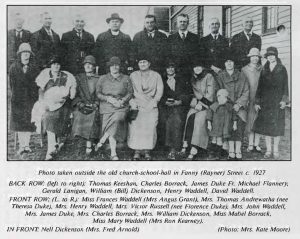
Pioneers of St Mary’s c. 1927
Henry Michael Russell Waddell was born on 15 March 1871 in Carlton, Victoria to parents John Waddell and Mary Ann Waddell nee Russell. Henry was the second youngest born of nine children, six of whom reached adulthood. Whilst the family originated from Launceston, Tasmania, Henry and four of his siblings were born after the family moved across to Melbourne around 1863. Henry was only seven when his father passed away and eleven when he lost his mother. It is not certain whether he was cared for by elder siblings but certainly three of these would have been old enough to take charge.
Henry married Honora Ulmer in South Melbourne 21 Nov 1898 at St Peter’s and Paul’s church. Honora Ulmer was born in Colac on 20 November 1870 to parents Johann (John) Gottlieb Ulmer and Bridget Bryon. The couple had six children, Henry Joseph (1899-1964), Mary (1901-1985), Frederick (1904-1986), Frances (1906-1994), Olive Elizabeth (1909-1991) and Catherine (1914-2007).

Honora Waddell
The Waddell’s moved to Altona from Kensington circa 1924. Originally living in McBain Street then later moving to Railway Street. His brother, David and his family, moved to Altona a few years later. Henry was a plumber and David a painter, trades which they freely offered to the St Mary’s parish in its early years. The family were longstanding residents of Altona assisting not only within their parish church but also to the larger community.

Henry and son Frederick Waddell
Henry Michael Russell Waddell passed away on 28 September 1946, in Fitzroy, and is interred within the Williamstown cemetery (RC-K, Row 17, Grave 5) and Honora passed away 23 August 1952, at their home in Railway Street, and is buried with her husband within the Williamstown cemetery in an unmarked grave.
In 1987, the Werribee Council undertook the redevelopment of a section of Altona Meadows located south of Central Avenue and east of the Bruce Comben Reserve, extending through to Merton Street. The streets in this area renamed in recognition of the contributions made by former and current residents of Laverton to their community. Seventeen residents were chosen for their role as Officers in Charge of the RAAF Bases at Point Cook and Laverton. One of these was Air Vice Marshall Allan Leslie (Wally) Walters.
Allan Leslie Walters was born on 2 November 1905 at Ascot Vale, Melbourne, second of five children of parents Ferdinand (Arthur) Walters, schoolteacher, and his wife Edith Mary Walters (nee Russell). Allan moved to Perth, with his parents, at an early age and was educated at the Perth Modern School. He spent four years in the senior cadets and eight months in the Citizen Military Forces before entering the Royal Military College, Duntroon, ACT in February 1924. In December 1927 he graduated as lieutenant but quickly transferred to the Royal Australian Air Force on 1 February 1928.
Promoted flying officer in February 1929, Allen Walters completed his initial pilot training the following month. He then undertook several courses with particular emphasis on flying instruction, at which he excelled, eventually achieving the seldom-awarded grading of ‘A1’. Allen became a member of No.3 Squadron based at Richmond, New South Wales, where he earned a reputation as an aerobatics pilot, participating in the air shows that were such a feature of aviation in the 1930s. Fair, slim and blue-eyed, he was said to have cut a dashing figure.
While courting his future wife, Jean Grace Belford, daughter of Reverend George Frederick Belford Manning, rector of All Saints Church, North Parramatta, he performed stunts over the church. Reverend Manning performed the marriage of Allen and Jean at that church on 30 June 1930. In 1936 Flight Lieutenant Walters graduated from the British Royal Air Force Staff College, in Andover, England. Now promoted to squadron leader in March 1937, he returned to Australia in that June and was appointed the commanding officer of No. 22 Squadron at Richmond, where he flew Hawker Demon and Avro Anson aircraft. He then commanded No.3 Squadron in 1938-39 before serving at Air Force Headquarters, Melbourne, as director of staff duties. Between 6 and 23 February 1938, Walters piloted the first overseas flight in an airplane designed and built in Australia when he flew the Chief of the Air Staff, Air Vice Marshal Richard Williams, to Singapore in a Tugan Gannet.
To counter the emerging Japanese threat in Southeast Asia, Australia began to deploy forces to support British forces in Malaya. In July 1940 Allan Walters took his No.1 Squadron, newly equipped with Lockheed Hudson aircraft, to Singapore. Commanding the squadron as a temporary wing commander, he led it until May 1941, when he became commanding officer, Royal Australian Air Force Station, Laverton, Victoria. To ensure that No.1 Squadron were trained ‘to a particularly high standard’, Allen took ‘a very active part in all operations’. For his attention to this training, he was awarded the Air Force Cross and was promoted to the rank of temporary group captain in April 1942. He spent twelve months at Laverton and then in May 1942, he joined Allied Air Forces Headquarters, South West Pacific Area (SWPA), in Melbourne as Assistant Director of Operations. He was made a temporary group captain in September and transferred to Headquarters RAAF Command as senior air staff officer.
The remainder of Allan Walters’ war service alternated between staff appointments and operational commands. His commands were No.1 (Fighter) Wing, Darwin (1942-43), No.72 Wing, Merauke, Netherlands New Guinea (1943-44), and Northern Command (1945-46). He was mentioned in dispatches for his ‘leadership and resource’ during operations in New Guinea, New Britain and Bougainville, and was then appointed Commander of the Order of the British Empire (C.B.E.) in 1946. His personal leadership was always demonstrated by his eagerness to be as personally involved in as much action as any of the pilots under his command. Promoted acting air commodore in February 1945, he represented the Royal Australian air Force at the Japanese surrender at Wewak, New Guinea, in September 1945.
After serving at Air Force Headquarters, as director of air staff plans and policy, Allan Walters attended the 1947 course at the Imperial Defence College, London. Allan was then promoted acting air vice marshal in October 1952, which was made permanent in January 1954. He held three major commands: Southern Area (1948-50), Home Command (1954-57) and Support Command (1959-62). He also occupied key overseas posts as air officer commanding, Royal Australian Air Force Overseas Headquarters, London (1951-52), and head of the Australian Joint Services Staff in Washington (1952-53). From 1957 to 1959 he was air member for personnel on the Air Board. In May-June 1956 he took commanded a flight of five Canberra bombers on a goodwill visit to the United States of America and was appointed Companion of the Order of the Bath (C.B.) that year. Allan was twice a candidate for Chief of the Air Staff position but was twice passed over.
Air Vice Marshall Allan Walters retired from the Royal Australian Air Force on 16 May 1962 and made his home in Melbourne. In retirement he enjoyed his love of horse racing and the fellowship of the Melbourne Club, of which he was a member. Allan Leslie Walters passed away on 19 October 1968 at the age of sixty-two, at Heidelberg. He was accorded an Air Force funeral at The Scots Church, Melbourne, on 22 October, and was cremated at the Fawkner Memorial Park. His wife, Jean, and their daughter, Robin, survived him. A plaque in the Victorian Garden of Remembrance at the Springvale Botanical cemetery is a memorial to the man and his service.
Research: Graeme Reilly (2025)
Back in the 1800’s at Mornington, a small seaside town on the Mornington Peninsula in Victoria, Australia, the main event of the day was the arrival of one of the Paddle Steamers at the Mornington Wharf. The local hotels and guest houses sent wagonettes and porters to the pier to escort guests to their establishments. When the paddle steamers departed to continue their journey to Sorrento, a procession of porters, trolleys and passengers headed towards the Main Street.
Paddle Steamers were a luxury form of transport on Port Philip Bay in the late 1800’s. They were used to transport tourists from Melbourne to Mornington, Dromana and Sorrento on the Mornington Peninsula, and Queenscliff on the Bellarine Peninsula.
By the turn of the century, there were 3 Port Phillip Bay paddle steamers in operation, the Ozone, the Hygeia and the Weeroona.
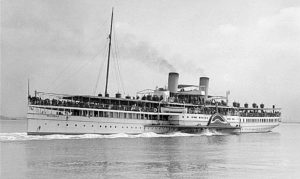 The PS Weeroona was the last of the Port Philip Bay paddle steamers to be built. She was launched by A.S Inglis of Glasgow in 1910 for Hubbart Parker and Company. She took 70 days to complete her maiden voyage from Glasgow to Melbourne via the Suez Canal, Jakarta, Thursday Island, Brisbane and then Sydney.
Larger than the other two paddle steamers, the Weeroona was 310 feet long (95 metres), constructed of steel, weighed 1412 tons and licensed to carry 1900 passengers. Again she was extremely luxurious with spacious promenade decks and impressive lounges and dining rooms.
The Weeroona serviced the resorts of Port Philip bay until 1942 when she was purchased by the US Navy who intended to refit her as a convalescent and accommodation ship. Departing Melbourne in 1943, the Weeroona travelled under her own steam to Sydney and then she was taken under tow to the Philippines via Brisbane and New Guinea by the US Navy. However, following the end of the war, the Australian Government purchased Weeroona from the US Navy, briefly using her for service until she was sold for scrap in 1951. She was stripped and sunk off Berry Bay in NSW.
Research: Graeme Reilly (Altona Laverton Historical Society)
In 1987, the Werribee Council undertook the redevelopment of a section of Altona Meadows located south of Central Avenue and east of the Bruce Comben Reserve, extending through to Merton Street. The streets in this area renamed in recognition of the contributions made by former and current residents of Laverton to their community. Seventeen residents chosen for their role as being Officers in Charge of the RAAF[1] Bases at Point Cook and Laverton. One of these was RAAF Air Commodore John Alan Whitehead.
Air Commodore John Whitehead DSO[2] seemed destined for a career in the military, particularly in aviation. John Alan Whitehead was born on 3 August 1933 in Rockhampton, Queensland to parents Edgar Francis and Lila Doris Whitehead (nee Worchester). John’s father was born in England who had served in the Royal Navy in WW1 (1917-1919) before joining the merchant marine service. Sometime after the end of the war, Edgar Whitehead made the decision to migrate to Australia, seeking more opportunities and a better life that England was offering. Edgar met and married Lila in Brisbane, Queensland in 1931 and the following year their first child was born, Pamela, and a further year later John was born.
When WW2 broke out Edgar Whitehead enlisted into RAAF and served from 1940 until 15 Feb 1946 as a Leading Aircraftman. By the end of Edgar’s his service, young John was now thirteen and influenced by this experience of life in the RAAF. During his childhood, John developed a keen interest in aviation, which led him to follow his father into the Air Force. When he turned sixteen, John’s mother filled out the necessary papers, and then he was off to Point Cook to attend RAAF College for four years. John’s career and life were now moving forward and he never looked back. What John soon faced was his first big career decision, would he choose to be on the ground as an engineer, or up in the air as a pilot. However, by the end of his first year, John had decided to become a pilot.
John Whitehead flew Tiger Moth and Wirraway planes in training and over the following 32 years he added Vampires, Meteors, the supersonic Hunter F6, Canberra bombers and training aircraft to that list. John also had interesting postings in his early career: first to Williamtown, Japan, and Korea with No. 77 Squadron, then England with No. 74 Squadron Royal Air Force, defending the British Isles against potential Russian onslaught during the Cold War.
On 30 September 1961, in Toorak, Victoria, John married Adrienne Diana Candy[3]. John was later to say that – Adrienne had come from an Air Force family, so she was used to moving around the world with her parents. She swapped that life for a similar one with me, and it has been great fun, and we have had many good times during our 62 years of marriage.
During the Vietnam War, the RAAF posted John to the USAF Air Base at Phan Rang for flying operations, completing 260 operational missions there as Commanding Officer No 2 Squadron RAAF. John Whitehead was immensely proud of the achievements of the Squadron during its deployment in Vietnam, as it consistently achieved disproportionately excellent results. For his leadership, drive, initiative, and interest in the welfare of his subordinates, John received the Distinguished Service Order in 1970.
After the Vietnam War, a career highlight came in 1971, upon the RAAF’s 50th Anniversary. John was appointed as the Equerry[4] to the Duke of Edinburgh during His Royal Highness’s visit to Australia for the birthday celebrations. Later, John gained promotion to Group Captain and moved to Victoria as Commanding Officer of the Aircraft Research and Development Unit at Laverton. Following this, he moved to Kuala Lumpur, Malaysia, to represent Australia in Defence matters. On 15 November 1977, John Whitehead as awarded the National Medal, an Australian award recognising long and diligent service by members of recognised government and voluntary organisations.
[1] Royal Australian Air Force.
[2] Distinguished Service Order (DSO) is a military award of the United Kingdom, as well as formerly throughout the Commonwealth, awarded for operational gallantry for highly successful command and leadership during active operations, typically in actual combat.
[3] Adrienne Candy was the daughter of Air Vice Marshall Douglas Candy.
[4] Enquerry is an officer of honour who attends or assists members of the royal family.